Every morning, if the weather permits, in the park there are, sometimes one, sometimes two or three groups of middle-aged Chinese women dancing, it’s not a very inspiring scene for me: the music is almost always sugary, and their moves, to say the least, amateur. (What drew me to New York was the Broadway dancing I encountered in a summer in Bryant Park years ago, and that’s something excites and amazes me still: the bold confidence to claim your stage in the world.)
And yet, there is a plain honesty in the groups of women in the park: they gather together from all walks of life, one might be a waitress works hard work to bring on the table the plate of food you ordered, another stands behind a counter in a 99 cents store for many hours a day……yes, there is a slovenliness in their appearance: they could hardly afford to be otherwise, still, they come and they dance, in the mid of the hard struggle of life, dancing to the sugary music about love.
And isn’t it always nice to see a group of women dancing in the park? It says an attitude toward life.
There is a Chinese idiom: 手舞足蹈 shǒu wǔ zú dǎo which, if literally translated, means hands waving feet jumping, it describes a person, when encounters extreme excitement or happiness, couldn’t not help himself but dancing: does it remind you of how children act when they are given unexpected presents, a puppy for instance?
Say, in the very beginning, nature’s hostility–“the heat of the sun, the furious winter’s rage”–must be a lot more fearful for the unequipped and vulnerable human race. Hard work it must be to get food for your belly. Imagine that you are always on the go, moving from one place to another in search of food, you could hunt, fruitlessly, for days. Then all of sudden, out the arrow shot, down fell the bull. What extreme happiness must that be? Could you picture that hunter “hands waving feet jumping”?
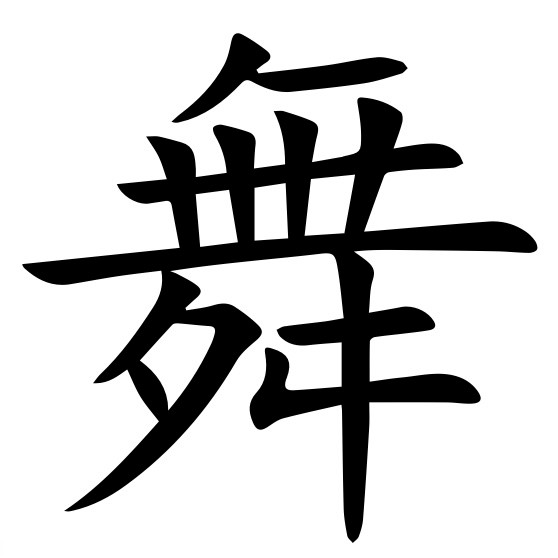
In Chinese culture too, the word dance 舞 wǔ, comes from sacrifice, a ritual slaughter. The Chinese too, after shooting down the bull, could not believe that it’s his own strength that did it. It must be the scary and all mighty one who lives up in the sky, he says to himself, who can throw thunder and raise winds if he is angry. To pacify the mighty one’s anger and gain his favor, human offers Him the meat of the bull, and with its long tail, human dances a joyful dance for the one watches from the sky.
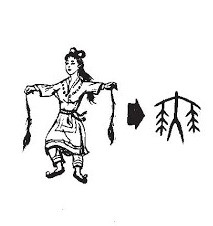
For a time it went to a variation of feathering dancing: when you decorate your head with feathers. Indeed, the dancing women in the park illustrate this feature by, sometimes, waving very colorful fans.
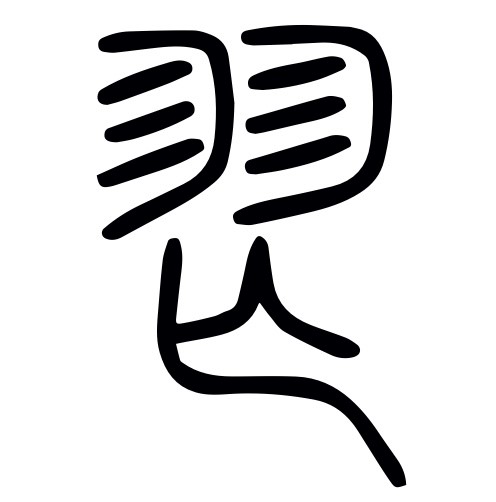
Then it again went back to its origin–a person, arms stretching out, holds bull tails in both hands:
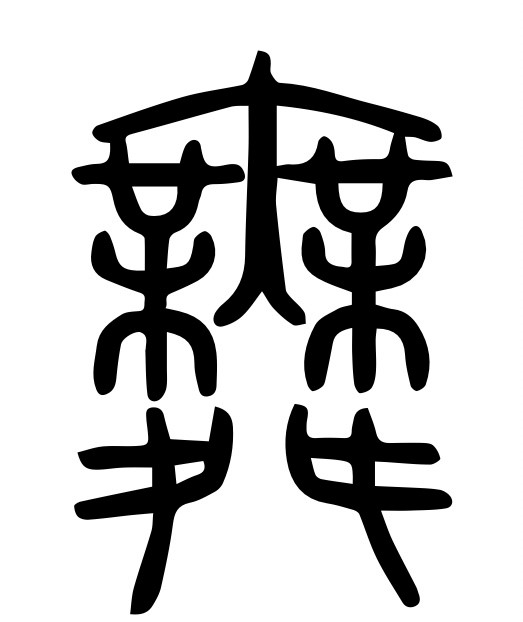
This is the character we use today:
I would like to think that the first Chinese man, at finally shooting down the bull, with the thought that his food, his immediate want now is secured and could be satisfied, could not, in his extreme happiness, resist waving his hands and jumping his feet, has something very similar with the women dancing in the park: they both celebrate life.
 Learn Chinese with Me
You must be logged in to post a comment.