A silvery spot–a quarter–shines in the green grass and distinguishes itself to my eye. Picking it up, I walk on and say to myself: now make a wish!
And I walk on, reviewing my life, trying to decide what it is I desire most at the moment.
祝 zhù, to wish, now mainly use as a verb, comes from the image of a wizard, or the person who presides over a prayer during the sacrifice, and, when the character first formed, it only meant “a wizard”.

Very soon, it developed the meaning “to pray”. And the altar, where they show the sacrifices to gods, appears:
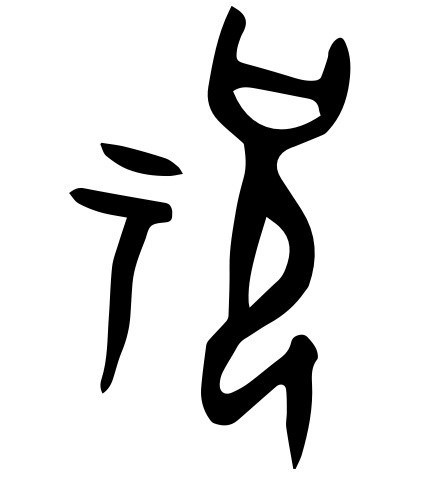
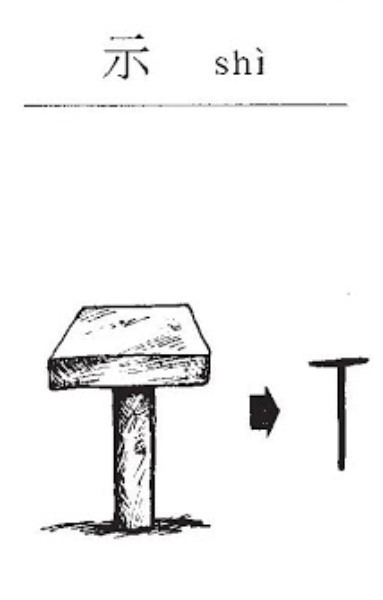
In its present version, the left part of 祝, the radical 礻, means “the altar”, and this radical, as it could be understood, mainly appears in character means “to worship, to wish, to pray, to revere…” , and the radical comes from the character 示 shì which is the image of the altar:
Interestingly enough, though it only means “pray for happiness or blessings” now, this word 祝 was, in ancient time, double used as 咒 zhòu “to curse”. And both in “to pray” and “to curse”, gods in the sky are not the only ones the wizard appeals to, according to the ancient Chinese dictionary, he also invokes the ghosts in the underworld to attend to his wishes.
“The wish is father to the thought”, the English phrase tells me. And with this newly begotten “thought” by my wish, I walk out of the park and walk up to my attic room and come sit at my desk at the window, and as I sit at the window and ruminate on my thought, I put away the quarter and pick up a book:
A Deed first Knocks at Thought,
And then–it knocks at Will–
This is the manufacturing spot
And Will at home and well
It then goes out an Act
……
Well, well, I’d better “knock at my will”, and let this wish of mine eventually “go out an Act”.
 Learn Chinese with Me
You must be logged in to post a comment.