What’s surprising is that, the word “free” — comes from old English freo “exempt from; not in bondage, acting of one’s own will” also “noble, joyful”– is also related to Dutch vrij and German frei, which are from an Indo-European root meaning ‘to love’, shared by friend.
Isn’t it good to know that “free” and “love” and “friend” share the same origin? It gives one quite a new way to look at things, for few would dispute that love has its bondages and friendship its obligations. But now with the knowledge that they all have the same root, a new interpretation comes to mind: maybe love and friendship, at its essence, should–instead of chaining one down–set one free.
The real reason, however, is not all romantic as that: it is said that the sense evolution from ‘to love’ to ‘free’ is from the terms “beloved” or “friend” applied to the free members of one’s clan, as opposed to slaves: think Roman Empire and Latin language.
The definition of 自由 zìyóu, the Chinese word for “free”, is 由自己做主,不受限制和约束 (let yourself be the master, unrestricted and unconstrained).
自 zì, self, comes from the image of a nose: think when you mean yourself, when you talk about yourself, you point at your nose.

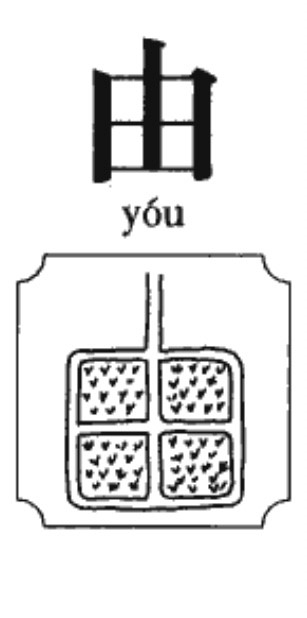
由 yóu comes from a path leading to a field:
“Be Free”, it is written on the shirt of the girl who was walking toward me, I lifted my gaze from the words to her face to trace some clue corresponding to the slogan she carried on her. But my musing was interrupted by another passing girl’s loudness: “I want everyone in tuxedo.” The sunglassed girl shouted to her earplug in the semidarkness of the early evening. “I am dropping 3000 dollars on my dress.”
I smiled: you cannot help but be amused by America sometimes, its loudness and confidence, and yes, the sense of being free, to do even things like “drop 3000 dollars on one’s dress”.
 Learn Chinese with Me
You must be logged in to post a comment.