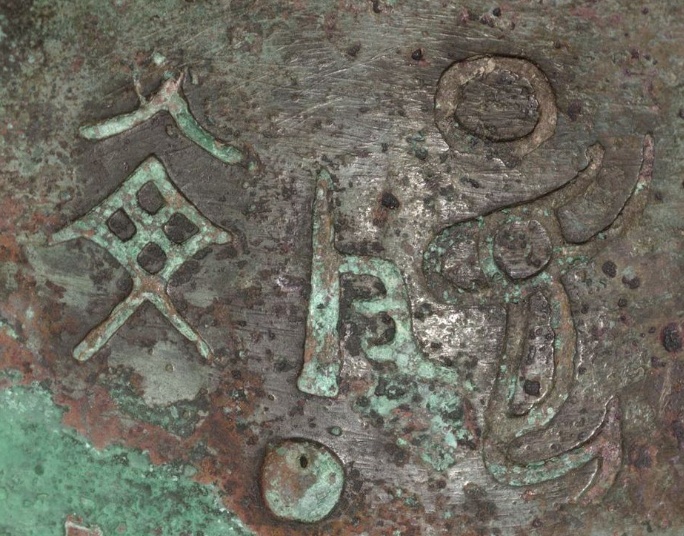
As You Wish

A silvery spot–a quarter–shines in the green grass and distinguishes itself to my eye. Picking it up, I walk on and say to myself: now make a wish!

And I walk on, reviewing my life, trying to decide what it is I desire most at the moment.

祝 zhù, to wish, now mainly use as a verb, comes from the image of a wizard, or the person who presides over a prayer during the sacrifice, and, when the character first formed, it only meant “a wizard”.

It emphasizes the mouth, as you could see on the top the big mouth opens wide to the sky where it’s thought gods–the ones he prays to and tries to please–reside.

Very soon, it developed the meaning “to pray”. And the altar, where they show the sacrifices to gods, appears:
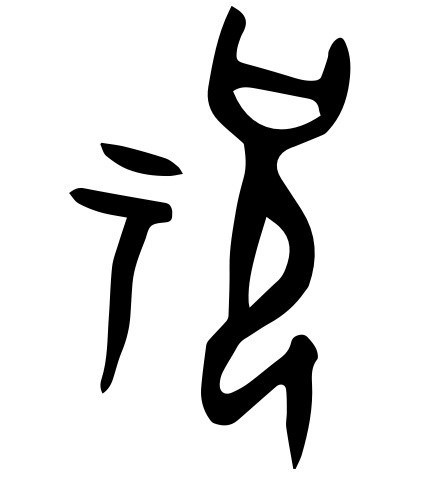
Kneeling in front of the altar–the left part–this wizard–the right part–again opens his mouth wide to appeal, to please gods with his prayers.

In its present version, the left part of 祝, the radical 礻, means “the altar”, and this radical, as it could be understood, mainly appears in character means “to worship, to wish, to pray, to revere…” , and the radical comes from the character 示 shì which is the image of the altar:
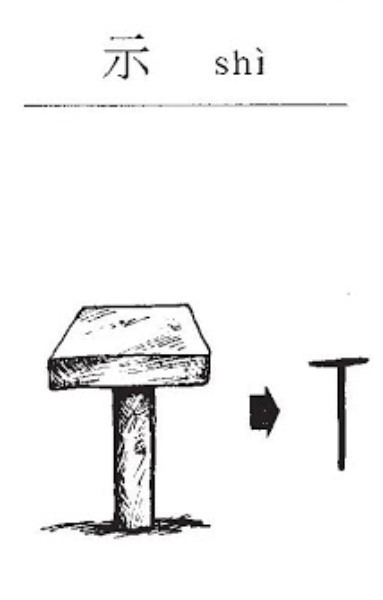
It does not, in this case, show the sacrifice.

Interestingly enough, though it only means “pray for happiness or blessings” now, this word 祝 was, in ancient time, double used as 咒 zhòu “to curse”. And both in “to pray” and “to curse”, gods in the sky are not the only ones the wizard appeals to, according to the ancient Chinese dictionary, he also invokes the ghosts in the underworld to attend to his wishes.

“The wish is father to the thought”, the English phrase tells me. And with this newly begotten “thought” by my wish, I walk out of the park and walk up to my attic room and come sit at my desk at the window, and as I sit at the window and ruminate on my thought, I put away the quarter and pick up a book:

A Deed first Knocks at Thought,

And then–it knocks at Will–

This is the manufacturing spot

And Will at home and well

It then goes out an Act

……

Well, well, I’d better “knock at my will”, and let this wish of mine eventually “go out an Act”.
Summer!

As I walk along, I shade my eyes from the glaring sun with a hand, and see a girl who comes towards me, mirroring my gesture: she too feels the need to protect her eyes from the dazzling white light.

And as I walk on, I carefully pick out my path as to stay continually in the shade. The hot sun–its fierce heat has no mercy–shines its strong light on all things under the sky.

A dog walker stands next to a tree, carefully keeping himself in its shade, a baby in a stroller crys pitifully as the mother pushes it around.

“It’s the heat. It’s the heat. It’s too hot.” The dog walker suggests to the mother who on hearing this lifts up the thin cloth that covers up the stroller.

The three benches in a row are all in the shade of two enormous trees, one is taken by a reader who, despise the heat, wears a mask and a face screen, another by a woman who is very anxiously looking at her phone. The old woman on the third one is about to leave. But on seeing me coming, she stops in her packing up of a shabby bag and looks at me:

“It’s nice to sit out in the park. Here nobody bothers you. Here they leave you alone. You can sit here all day long in the shade and nobody would bother you. In my room it’s too hot, it’s too hot. I sweat. I sweat all the time. The walls are old and they hold the heat. I could not sleep at night, I open the window, it’s no use, I still sweat. I have no privacy. I can hear everything my landlady does. I have no privacy. Here in the park I can have my privacy, here in the shade I can cool myself.”

A few steps further on the lawn, I see some others bear the heat much better than the unfortunate old woman, they in fact rather welcome the heat: these sunbathers have spread them out all over the grass, seemingly taking up all the heat of the sun with enjoyment.

Summer, 夏xià, in Chinese interestingly both mean the season summer and the Chinese people (华夏huáxià), or the group of people who at that time called themselves 夏人xiàrén and lived along the midstream and downstream of the mother river (黄河huánghé) where Chinese people started.

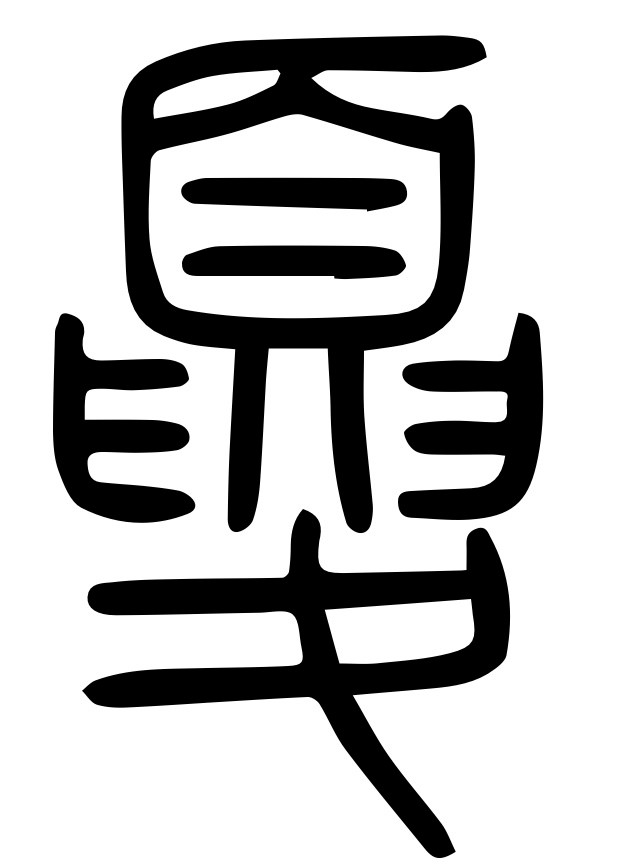
The first dynasty in China (2070 BC–1600 BC) also called themselves 夏xià, and looking at the dictionary, it tells me that 夏 xià means “Chinese people”. The character itself is a picture of a person:

The part on the top–頁–means ‘head’, the one at the bottom–夊–means ‘two legs’; and the one in the middle–臼–means ‘two hands’ : it’s an image of a person of this particular race who called themselves 夏 xià.

But the meaning of the season summer of this same character is as ancient as the race itself. Some scholars find explanations from the very first symbol of 夏:

This buoyant sunbather places himself directly under the sun: the very top part means “the sun”, and below it–you could see his head and body and legs–is the person.
On the right corner–if you looked very closely–you could see the sun and the person under it.

And is it at all surprising that the brave race five thousand years ago along the Yellow River called themselves “the sun people”, “the summer people” when the sun gives light and gives life to everything(the sunbathers in the park know it)?

So summer 夏 is about the sun, and you might take it to your advantage, staying in the shade at times and at other times getting “your moment in the sun”.