Dreams

We are such stuff as dreams are made on, and our little life is rounded with a sleep.

—William Shakespeare

It’s at the museum of photograph downtown, and we are looking at photos of people and things.

The past two days seem like a very long talk, talking about the stories of each other’s lives. Ease and openness communicates itself, and it’s like a mirror, your relaxation reflects back to you in the other person’s response.

Intimate human communication must feel like this, I think to myself, that it makes you feel free to throw off all the masks, the doubleness, the uniforms that are imposed on you, that it makes you feel free to be yourself instead of having to prove or justify yourself.

Then, as a word, a scene, a feeling comes back to me: maybe we but have made a little step. For it must be so difficult, that we all know, even the four-year-old little boy knows, that we are expected to be in certain ways by parents or peers or society, and maybe most of all, by ourselves.

The people, punks in the seventies and eighties in London and New York, look back at me in a defiant or nonchalant gaze. Their outfits too—persistently meant to astonish—are like a statement of their attitude towards life.

What make us put this dress or that clothes on?

What makes us, in life, do this and that?

If you think about it, the driven-force behind it all may be simply a thought, a dream, an idea of ourselves.

“Waiting for something to happen”, so the little singing girl married the big bluebeard. And I, like the person at this moment standing so close to me, have been urged on by a thought, a dream, an idea of life and myself, and, oh odds and chances, as if in a dream, here we are standing next to each other in a museum looking at photos.

梦想, the Chinese word for dream, is defined as such: dream is a kind of expectation for the future. It refers to the situation that thinking about the future in the present or a hope (an ambition, a goal in your heart) can be achieved but can only be achieved with hard work. Dream is a thing that makes you feel persistence is happiness, and dream can even be regarded as faith, a kind of belief.

梦, the first character, also means dream itself, is about a person sleeps under a roof in a bed in the night.
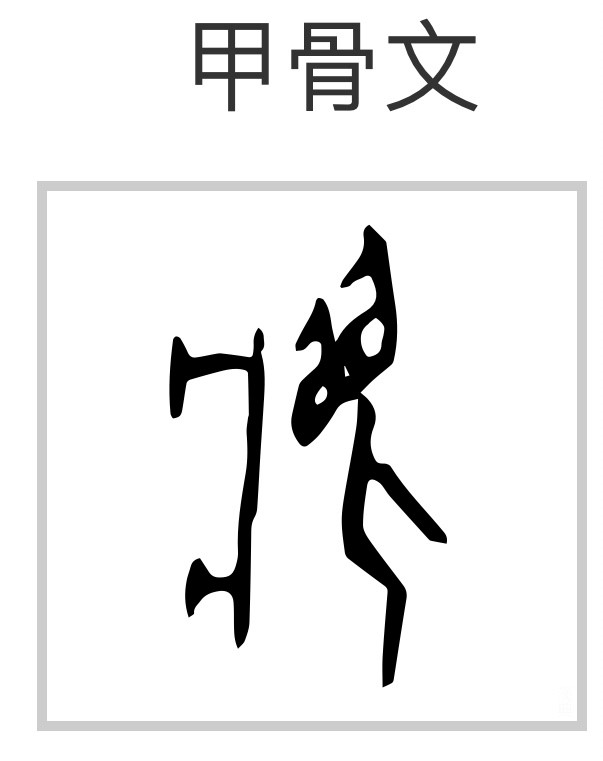
This very big person (on the right) with conspicuous eyebrows and eyes lay on his very simple bed (on the left) dreaming.Though through long evolution, the character now takes a completely different form: 梦, the upper part is 林 which means jungle, forest: indeed it could be a dim and dark place that inspires the image of dreaming; and lower part is 夕,the character represents a cresent, means dust, evening as the time for dreaming.

The original meaning of 梦, interestingly, is “not clear, blurry”, and its pronunciation is similar to 模糊 the word for “vague, dim”.

想, the second character, means to think and miss and envy; it means to hope and want and anticipate. 想 is, the ancient dictionary tells me, the eye sees and the heart wants.

How strange life is, that on the outskirt it’s built on such solid stuff: we eat our three meals; we put our clothes on; we sleep under a roof in a bed; we walk on the street and take the trains. Yet what chances, what images we have encountered on the way, what oddities that we should now, today put on this particular outfit, walk on this street, come to this museum and stand in front of these photos.

Yet—how I have wished we could dream together—we must carry on with our own dreams. And it’s with sprightliness we walk on. If there is a hint of sadness, it’s the sweet sort, knowing that the Perfect Day has been there and will be there, knowing that dreams have been and will be urging us on, and we have no choice but to be ourselves.
Color and Dye

Your absence has gone through me

Like thread through a needle.

Everything I do is stitched with its color.

—Separation by W. S. Merwin

It’s like having been out in a storm for a while, even now you are safe indoors in quiet and tranquility, the wind and the rain would still remain with you and blowing in your ears and beating in your mind.

It serves the food for the brain, the companionship of someone or some event that has happened, for quiet hours, in the shape of reflections during walks and odd moments of your day when your mind is not occupied by work or cares.

The little girl, for already she knows, more than I do, that when Little Blue hangs out with Little Yellow, they could temporarily change into Little Greens. When children feel no surprise at it, we adults marvel at the simple truth that we are, maybe by being a little bit too defensive or self-assertive, mostly blind to.

We rub off our colors to each other as we are in each other’s company. And these colors remain with us after the seperation, at first perhaps vivid, then we digest it, similarize it, absorb it until it becomes a part of us, a part of what our lives are made of.

颜色, the Chinese word for ‘color’, is combined by two characters ‘颜’ and ‘色’.

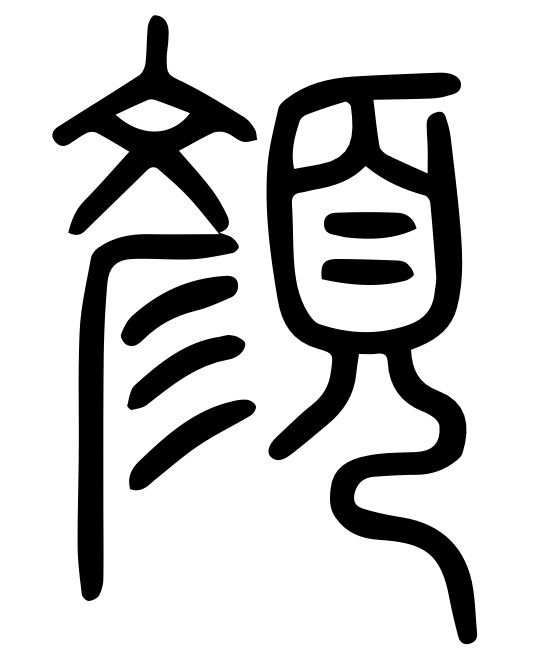
颜—no you would never guess it—original means “印堂”, a medical term used in acupuncture, is an area in your face, the area at the top of your nose bridge connecting the eye-brows.

‘面容,脸色’, —face, contenance—is a natural extended meaning, and in《诗经》, Poetry, there is this delightful line:

有女同车,颜如舜华: there is a girl who is in the same car with me, her face is like a hibiscus flower.

无颜见江东父老, no face to see hometown people, this idiom comes from the man, a hero, feels ashamed of his failure, chooses jumping into the river rather than crossing it to face his family and friends. There is a poem to prove it:

生当作人杰,死亦为鬼雄。

至今思项羽,不肯过江东。

The left part tells the pronunciation ‘yan’ and the right part the meaning: you could see the person on his two legs, his face and the his forhead or more precicely: the top of the nose bridge connecting two eye-brows.

色, but it reminds me of the flat persons when you enter into the hall of Met, turn right and come to the ancient Egypt area where the people were drawn into simple lined profiles. The big ones are the rulers and the small ones are the ruled.

Strange, or maybe it’s not strange, that in all human history, or could I also say—without appearing embittered—that in many human relations there is the one dominates and there is the ones is dominated.

Because 色 is one person carries the other person on his back, and he looks up to his face.

The smaller person on the left, is the oppressed who looks up to the bigger one on the right and is dominated by his contenance.

色, from the meaning ‘face, contenance’ naturally develops into ‘good-looks, woman’s looks, beauty’ as in 姿色,美色.

Then ‘lewdness, erotic’, there is a movie Lust, Caution, 《色戒》.

In Buddhism 色 means ‘the material appearance of things’, think of the sober plain color of all religious garments.

So the Chinese word for ‘color’ 颜色 originally means a person’s face, his contenance, there is this phrase 和颜悦色, pleasing contenance.

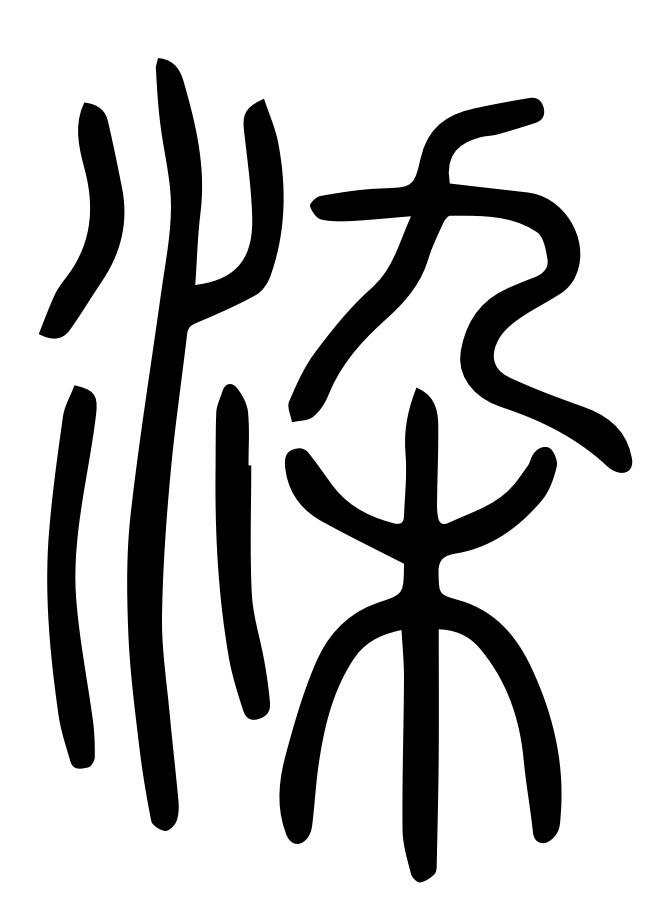
染 to dye, is self-explained: there is wood in it as ancient dyes are mostly derived from plants, there is water in it as dyes must be processed into liquids, there is the number—九—nine in it (here means multiple times) as the dyeing must be repeated.

There is the flowing water on the left, the number 九 on the upper right, and the wood, the plant on the lower right.

And the story goes, the little girl listens with rapt attention, that the Little Greens eventually change back to Little Blue and Little Yellow, yet, they were Little Greens for a while, and the memory of it must have been recorded in mind and body.

And I take my walks and go on with my daily occupations, yet last night seems to set up a persistent background of all things I do and it colors up me and all my thoughts.