Deed

“Our deeds determine us, as much as we determine our deeds.”

A wise woman once thus said.

A good thing comes out of getting older, maybe not at exactly being wiser, but being able to stand out of things a little bit and look at it in an objective view, a sort of convenient detachment.

A pang might touch one as acutely, yet one now has the power to take hold of the knife and analyse its source of thrust and its sharpness.

In the process of it, one forms one’s judgement. To be a well-judging person, however, must be a lifelong learning exercise. Our friends, or the affairs of this world, if one-sided, it would certainly help us to determine the truth. Yet, there is always a mixture of good and bad in people and things, and they look like one thing from one mirror, another from another.

One way to get hold of it, perhaps, is by their deeds.

作为, the Chinese word for ‘deed’, has a heroic sound in it, 大有作为: being able to give full play of your talents and make great achievement.

The first part of the word, 作, simply means to rise and start and do. 日出而作,日入而息 rise (and work) with the sun, rest when the sun sets, is a vivid portrait of the free and simple life of people in ancient time. 困于心,衡于虑,而后作 confused in your heart, weighing and measuring in your thought, then you know what to do.

The Oracle version of 作, instead of “roll up his sleeves” to get himself ready for work, the ancient Chinese turns up his collar, and this image is thought to be a turned up collar, a made collar, whatever the fashion to make it, might also indicate “rise, get up from bed” which is the original meaning of this character.

为, the second part of the word, is no more and no less than a hand and an elephant: the human hand leading the diligent elephant to work, and so indicates the meaning: to do, to work, to act. 事在人为, the idiom goes.
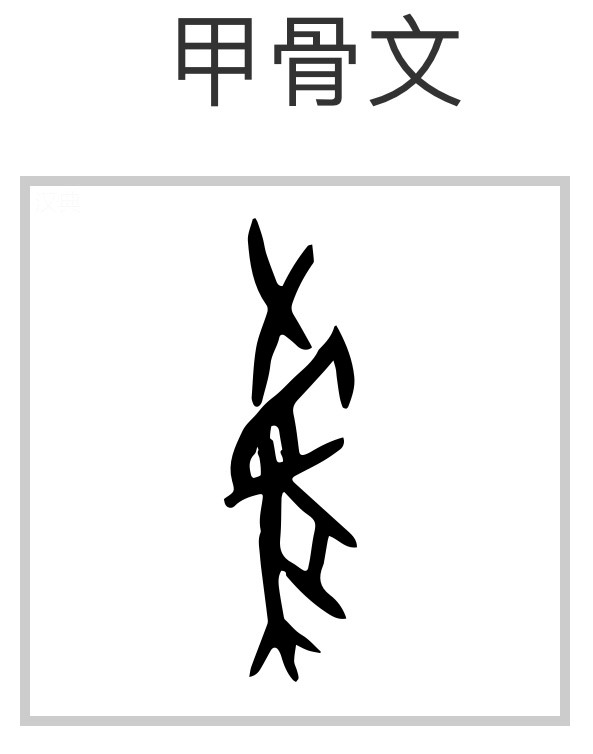
The hand (the two crossing strokes on the upper side) and the elephant ( the lower part). One could see the nose of the elephant, one could feel there is a sense of partnership between the leading hand and the reaching nose, the man and the beast.

We look back, we see their deeds, we see our own deeds, we reflect, we trudge on with the optimistic thought that we will fare better yet now we know better.

The little girl cries, in her confused hurt, she feels, or she talks herself into feeling that she is being neglected, there is also her explosion of energy, growing energy, that bursts out of her, adds to her confusion and she cries then laughs when the tear has yet hung on her cheek.

She has her perfect excuse, at being six years old, of taking everything so keenly, and when a feeling comes it bursts on her and swallows her up like a huge balloon. Luckily, the balloon will be soon gone, and the sky becomes clear as suddenly as it becomes stormy.

We, being adults, could, or it’s to be hoped, judge better in our confusions. We look at it, we turn it around, we say to ourselves, quoting old wisdom, “Our deeds determine us, as much as we determine our deeds.”

Shy People

It’s interesting psychology that when you reveal an inner self to someone, you somehow after the act find an anger, an irritation and shyness in yourself against the someone.

害羞, I looked at the chinese dictionary, ‘shy’ is a word that could also be called ‘ashamed’, it means to feel embarrassed, it can also be embarrassing if you feel uneasy because of timidity, fear of strangers or fear of being laughed at; fear of your shortcomings being exposed in the sun will make others look down on yourself; ordinary people can also be afraid, shy people are mentally sensitive and are overly scared, you will feel blushing, rapid heartbeat and other normal reactions.

While the English word ‘shy’ mainly comes from “to shun”, the Chinese equivalent 害羞 has a more amusing origin and implies a more layered, complex meaning.

The first part 害 means no less than “injure, damage”, and where this injure comes from? 口 the mouth(words). Which mouth? The mouth under a roof 宀. And those words that start at home is seen as a source of injure and damage (the Chinese knows the importance of maintaining the peace at home.)

害, starting from its original sense of “injure, damage”, evolves into several other meanings: to kill, to murder 杀害; be shy, be afraid of 害怕,害羞.

The second part 羞, you would never guess, comes from the image of a hand holding a sheep: the ancient custom of paying tribute to the ruler. And it originally only means “to pay tribute to”.

The left part with the horn on the top means the sheep while the right side, the fork made with two crossing strokes, is the hand that holds the sheep.

Later, as the hand at some point for some reason turned into 丑 “ugliness”, the meaning “shame, shy, mock, insult” comes in.

So there are lots of feelings mixed together in this one word 害羞. And ultimately, it’s not the someone you are against, it’s about you and yourself. It’s the fear of exposure, the anticipated hurt of might be laughed at: it’s a feeling we are all familiar with. Who among us could say he is completely comfortable with himself and have never experienced 害羞?