Politeness

In the middle of the lesson, the little boy lifts up his face, looks at me with an open and frank grace characteristic of his age, and says: “我们说再见,好吗? ” (“Let’s say goodbye, okay?” )

He does not yet know he is not being polite by saying that, being but four years old, and I could not help smiling at this truthfulness, indeed who could take offence from a child’s babble? 童言无忌 as the Chinese idiom goes.

Many wise men throughout history had something to say about politeness:

–True politeness consists in being easy one’s self, and making every one about one as easy as one can.

–A union of kindness and independence

–Politeness is the result of good sense and good nature.

–There is a politeness of the heart, this is closely allied to love.

Yet not all that said about politeness are praises, some took quite an opposite turn:

–Politeness is organized indifference.

–The most acceptable hypocrisy

–Politeness is fictitious benevolence.

–A tacit agreement that people’s miserable defects whether moral or intellectual, shall on either side be ignored and not to be made the subject of reproach.

Nietzsche even, unsurprisingly, went so far as to call politeness “that roguish and cheerful vice”.

礼貌 is the Chinese word for ‘politeness’, it consists of two characters.

礼 comes from “hold rituals and worship god for blessings”, the left side of the character is 示, the altar used in the ritual, and the right side is the vessel used in the ritual, the ancient sacrificial offerings.
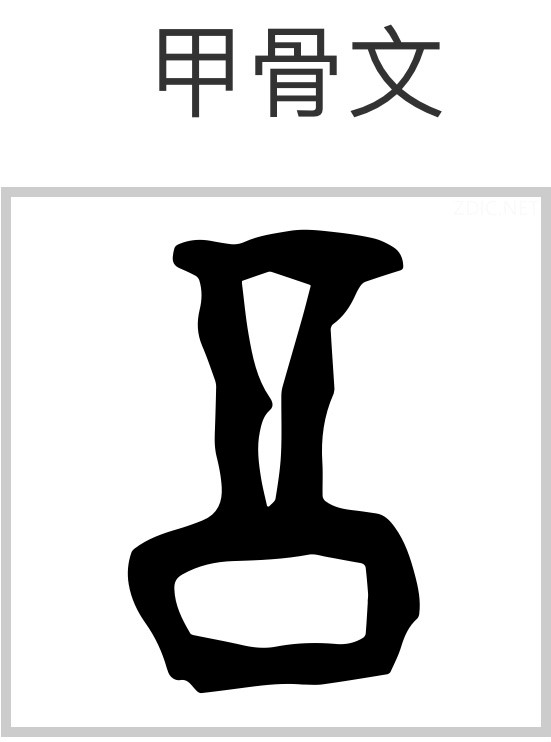
The altar as in Oracle bone script.

The ritual vessel as in Oracle bone script.

The same image of this ritual vessel was the Oracle version for 礼, the first half of 礼貌 “politeness”. The altar on the left side of the character was added later on:

This version, much resembling the character we use now 礼, has the altar 示 on the left side and the vessel 豊 on the right side.

貌 the second half of the word 礼貌 ‘politeness’, has the meaning of “countenance, appearance”, and it comes from the image of a human face.
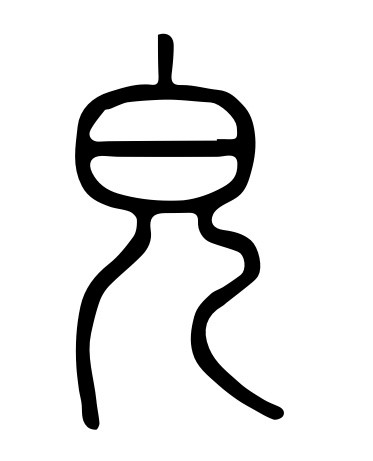
This is the beginning of 貌, and this is how they drew a human face at that time.

So the Chinese way of understanding “politeness” is that it’s a ceremony, it’s a courtesy, it’s etiquette, it’s a gift, it’s to respect and to worship; it’s also, an outward appearance and could be superficial.

And the Chinese, indeed, takes a sobering honest way in the expressions of most common politeness:

没关系 it does not matter, as a response to ‘sorry’, literally means ‘no relation, no impact’.

谢谢 thank you, comes from the original meaning “to decline”. (Can you wonder when, it is safe to assume, you must have clicked on ‘No, thank you.’ many times?) And that might be why at times the Chinese could feel uncomfortable when you say 谢谢 to him, because he thinks you are pushing him away to keep a distance.

Woman!

“Be the Doctor Your Mom Wants You to Marry”.

It’s said one woman in Brooklyn, after she saw this quote on someone’s shirt, went on and became a doctor.

How surprising it is, it makes one feel, that a few words should have such power!

And how unsurprising it is, when you think about it, that there are still in this very modern world few women that do and excert and achieve mighty things on a bigger stage at a higher level.

Of course it makes a woman feel flattered and pleased, and admittedly it is a good and natural and honest feeling, at being looked at in a way a man would look at the one he adores and holds dear.

There is a quickening of blood, a flutter in the heart and a flush in the face. One feels warm and gentle, like basking in the ray of a brilliant sun on a winter afternoon. One feels shone on, like a light has suddenly been turned on and makes everything in life looks cheerfull. And one feels, oh these must be counted as precious jewels in one’s memory, like dancing and singing and prasing life!

In a word, one feels happy!

How many women must have slipped and lay under these feelings throughout history! The fortunate, leading a life of sacrifice and anonymous, became the blurred faced wife behind husbands and sons. The unfortunate, well, the unfortunate probably lived the same kind of life without there being a light, a warmth and gentleness, a sun in her self-effacing life.

What is it makes a girl feel instinctively at once maternal and humble as a servant towards such a man?

女, the Chinese dictionary tells me, pictogram, Oracle: the figure of a kneeling human with hands holding together, original meaning, female, woman as opposed to “male”.

The 甲骨文, Oracle, version of the Chinese Character looks like this.

女,妇人也, the ancient dictionary goes on to explain. And I went on to look up what exactly is a “妇人”, woman.

妇, compound ideographs, Oracle: on the left side is “broom” and on the right side is “female”, the female holding a broom, it means to sprinkle and sweep, original meaning: married woman.

The Oracle version of this married woman.

女也不爽,士贰其行, the dictionary now gives me examples of 女 used through out the history of literature, rough translated, the woman (wife) has no fault, yet the man (husband) doubles (changes) his behavior. (no longer loving).

一女不织,或受之寒, (if there were) one woman does not weave, there would be someone suffers cold. [Preceded by 一夫不耕,或受之饥,(if there were) one man does not plow, there would be someone suffers hunger].

窈窕淑女,君子好逑, graceful maiden, a gentleman’s good life companion.

So the female, she is the decorous kneeling figure, she is the sweeping housewife with a broom, she is the wife with no fault yet the husband has wronged her, she is the stay-in-home weaver, she is the genleman’s life companion.

What she is not, is 男, man, and the dictionary says thus about male: the power in the field (to plow), the one who works, strives and achieves.

男有分,女有归 it says, each man has different occupations, each woman has her husband to rely on.

The west on this aspect shares the same mind: ‘woman’ comes from the word wife: wife, in a lingusitic sense, is seen as a woman’s sole role. Whereas ‘man’ comes from ‘mankind, human being, person, to think (!)’, his role certainly is not limited to ‘husband’.

“But I would rather be happy! Isn’t happiness the most important thing?” She asks me. “Why all these scholastic dead knowledge? You make a simple thing so complicated!”

Yes. It’s certainly much better to be happy than to be wise. Then it is the wise woman who are oftener happier. There is happiness in the knowing of oneself, there is happiness in the pursuing of knowledge.

The fluttering feelings are all very well and precious, and better to be savored and treasured up deep in the heart for its purity, the head, however is to be clear and sober. In a long run, it’s much better to be the doctor yourself than worshipping and serving a doctor. For, if this doctor walks away, for after all such things happen in this world, you would not be left destitute, and if the doctor stays, for happy companionships, happy marriages do exist too in this world, you would deal with him on an equal ground, which is the foundation of any healthy relationship, and not end up being, or at least that would not be your main role, the sweeping wife with a broom.