He looked at me in such a way as to make me feel uneasy. And I, the decision was made instinctively in a second, stood clear of him, put a distance in between and only skated around in the further part of the square. I thought if I kept away and ignored him, he would eventually leave. The square was quiet, but not infrequently visited, indeed only a minute ago there was a middle-aged, laborhardened woman, coming out from one of the paths in the bush leading up. And she, at the sight of the skaters downstairs in the ring, stopped in the middle of her steps on crossing the square, gazed a while before walking away.
When I attempted the pass connecting to another square–I thought I would feel more at ease if I stayed at a different square from him–I kept my eyes averted from him as I came close, for he was not very far from the pass, and as I came close, he made such sounds as to diminish and dehumanize: a sort of smacking of the tongue and lips.
Later when I caught a glimpse of what he was doing–he now, in the square I just left, sat directly across the pass so he could have a full view of me and I of him–I did not feel threatened, but disturbed, disgusted and annoyed.
I directly called out for help: there were park staff downstairs at hand, and they directly came. In the course of me leaning on the railing talking loudly to the people downstairs and they getting the message. The man at the other square was not afraid, he covered himself and stood up and listened to ascertain what’s going on, he lingered on still even after he understood the situation, and when he eventually took up his electric scooter, it was without any haste, he walked towards the bush and disappeared.
Later when I walked down–it’s really less than a two-minute walk to the busiest part of the park–I saw little girls in pink dresses tottering around. The sight of them and the thought of what just happened at so close a proximity sickened my heart me: this is the world we bring them up into.
The disturbance of the mind continued to the next morning, and occupied my thoughts throughout my long walk.
Is it a violence unto oneself? I wondered, when a man does such a thing.
And he won’t wake up a new person the second day, it’s reasonable to assume, what he did he probably had done before and would do again, and there is the possibility, if he continues on that path, he would at some point become dangerous to women.
And I wondered about the psychology of this, is it power he felt? To diminsh and impose and assert. And, it was unlikely, that he took it into his consideration that it was an extremely unpleasant thing to the other person.
What is the process of this? Surely he was a new baby born of a woman in the very beginning, what is the process from that baby to this man on the square?
I walked on and thought to myself. You have to be smart in New York, especially when you are a woman, you have to be aware and be mindful of potentially unsafe situations, for potentially unsafe situations there are and will be. And you have to protect yourself and keep away.
The original sense of the word ‘smart’, it’s said, is ‘causing sharp pain’, and from this arose ‘keen, brisk’, whence the current senses of ‘mentally sharp’ and ‘neat in a brisk, sharp style’.
聪明, the Chinese word for ‘smart’, could be plainly explained: 聪 acute hearing (to listen well) and 明 clear sight (to see well).
Yes. The world for a woman could be dangerous, and this, the little girls in pink dresses have to be taught, you have to be smart and protect yourself.
But that does not mean you cannot go out in the open and enjoy skating, or anything New York, this world could offer.
Do not give the power away. Walk away, run away at potential danger. But do not give the power away: the power to stand and be and feel free in the open.
“Turn the table around” I thought to myself and quickened my steps, “turn the table around. Use this experience to strengthen yourself. Become stronger and smarter and better equipped to fight and enjoy.”
“To speak the truth, reader, there is no excellent beauty, no accomplished grace, no reliable refinement, without strength as excellent, as complete, as trustworthy.” Thus says one of the finest women, Charlotte Bronte, in her best novel.
力 the word for strength in Chinese, comes from the image of the shapes of human tendons:
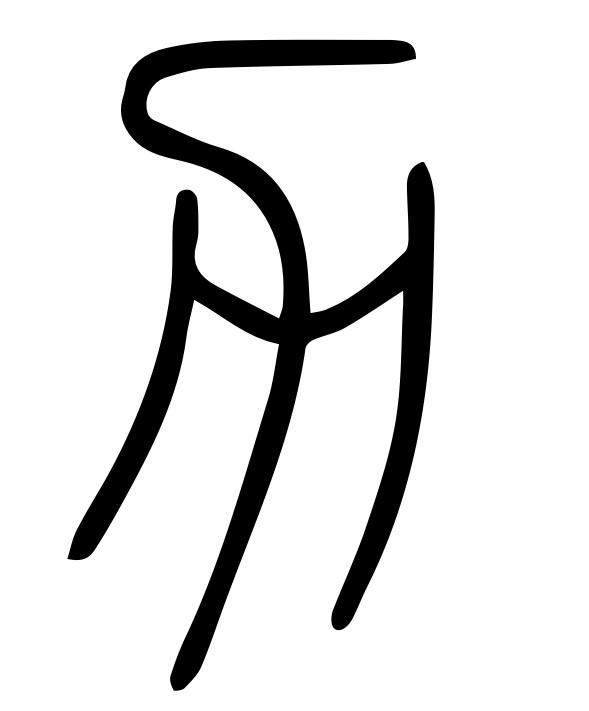
And it is well, after putting on pink dresses on little girls, to teach them to be strong.
 Learn Chinese with Me
You must be logged in to post a comment.