On Time

Three green benches in a row appeared into view, all unoccupied. I halted, gazed and considered. The early morning sun was still low behind some buildings, and all the three benches were in shade. I eventually chose the one on the side next to a cluster of bushes that promised the most privacy as much as an open space in a park could render. I then opened my book and presently was absorbed into another world.

Though the present world before long called me back. As I looked up from the pages, I saw that the sun now had risen high behind some tall trees, the spot I sat on was now in its white light, the heat had been accumulating, and now reached to an unpleasant degree. I accordingly moved, and in the course of the morning, I moved once and again from one bench to another as the sun moved and put now this bench in shade, now that.

The Chinese, from the very beginning, knows that time is about the movement of the sun. They put a sun 日rì in the character ‘time’ 时shí.

And it’s a pleasure to think that the Chinese tells time this way: they must have stood under the sky, gazed long and considered hard at the sun to be able to tell the precise time.

Indeed the character explains itself this way: 时shí, the left part is the sun 日 rì and the right part is a length unit 寸cùn.

Of course they made a 日晷 rìguǐ after all the gazing and considering and calculating:
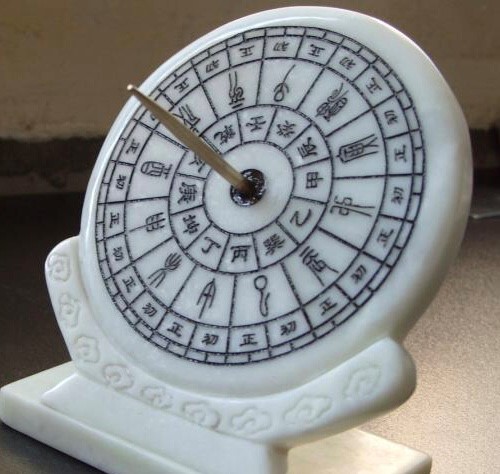
Time, in this case, would be told by the sun which casts a shadow of the stick in the middle upon the disc around it.

But the character 时 in its origin means not the time, the hour, the moment as it means now, but the four seasons ( Is this the reason that 时 sounds very similar to 四 sì four?). Though, despise the variation of meanings, the character from the start never deviated from the sun.
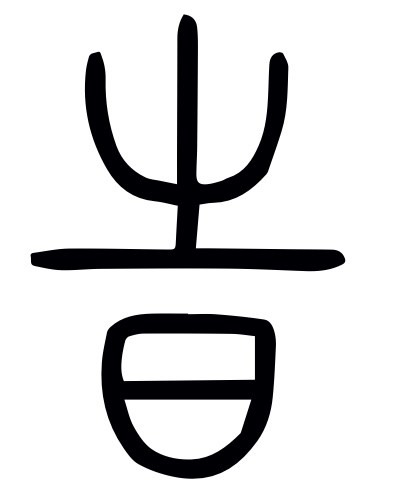
The upper part 出 chū means “out, coming out” from the image of grass coming out from the earth, and the lower part is the sun 日 . And the character that now means ‘time’ in the very beginning literally means: Here Comes the Sun.

Later on ( though not much later, still far, far back from recent) the Chinese adds another character to mean time 间 jiān, and till today 时间 shíjiān still means ‘time’.

间 , as I look it up in the dictionary, proves to be a character that delights and worth much noticing: it all comes from a crack and the moon!

夫門夜閉,閉而見月光,是有閒 隙也 fū mén yè bì, bì ér jiàn yuèguāng, shì yǒu jiànxì yě: the dictionary thus explains the character: the man closes the door at night, though it’s closed he still sees moonlight comes in, it is because there is a crack(How delightful! They could make a character out of this!) And indeed, this character, the outer part is the door 門 or 门 mén (I do hope you would think it does look like a door.) and the inner part is the moon 月 yuè.

And this crack 间 went on becoming bigger and more important and now it means ‘time and space’.

Now the Chinese from the very beginning knows time is about the sun, about the movement of the sun: it moves a certain space in the sky and indicates a certain length of time. And not long after that–as astonishing as it sounds–they also figured out what Einstein would explain about two thousand years later in a more elaborated way that time is space, and that’s still how the Chinese interprets time today 时间, time and space are one (Yes. We certainly are an astonishingly smart race! Well, at times!)

So when the Westerners gaze at the sea to watch the tide–the English word ‘time’ comes from ‘tide’, the Chinese, being mostly inlanders, watches the sun moves across the sky, the four seasons come and go, the moonlight comes in through the crack, and says: “一寸光阴一寸金,寸金难买寸光阴 yī cùn guāng yīn yī cùn jīn, cùn jīn nán mǎi cùn guāng yīn“.
About to Happen

‘Men work together,’ I told him from the heart,

‘Whether they work together or apart.’

This line of a poem came to my mind as I sat at the steps in the drizzle that threatened to turn into a storm very soon, waiting anxiously, minute by minute, for a man and a van that I did not know would show up or not.

In the previous two days I had contacted one man after another, one in particular who had helped me before, asked me to send the details which I did, a very detailed information indeed, and an hour past, then another……by noon when I still heard no reply, I sent out another message which was ignored as well, feeling all exposed and apprehensive by giving out all the private information and hearing no reply, I decided to break the suspense and call the guy, I was answered in a tongue which I could not determine, and at hearing my voice and English, he grumbled something and hung up with rude abruptness.

It was an unpleasant interaction enough. Though I could not say what the matter was. The man( I could not tell if it’s the same man) seemed gentle enough last time I used their service.

I went on and contacted several others but only fruitlessly: New York is all of a sudden full of business and no one is available.

In my distraction I knocked on my neighbor’s door who has, indeed, been living in this Latino neighborhood for the past thirty years, he referred me to the car service center at the corner.

“No problem. No problem. Nada. Nada. They can get you a van and a man.”

Off I ran to the center and stated my case. There is a something very similar to brotherhood in the air of the small office. And I was told a van and a man would come to me at the appointed hour. Then he held out his fist in the air, and I saw that I was offered a fist bump which I readily answered with my own fist.

I let out a breath as I walked out of their office. Though still I was not settled; Still the uncertainty in me remained: I have never used car service in this country, let alone the car service of this particular Latino neighborhood.

As I walked on the busy street looking for an ATM to prepare against that they might only accept cash. I sent out a message to announce my arrival of the following day.

I was a little uneasy about the disturbance in the early morning, though I thought the notice ( perhaps not the early hour) necessary and a form of politeness.

I did not get a reply, and meanwhile, my heart misgave me.

Adventure, it’s said in the dictionary, is based on Latin adventurus ‘about to happen’, from advenire ‘arrive’.

And both in English and Chinese, the word has a two-sided sense of “hazard, risk” and “daring and exciting”, though perhaps the English leans more on the “daring and exciting activity calling for enterprise and enthusiasm” while the Chinese considers it more a reckless act regardless of danger.

The Chinese, is it fair for me to say (and sorry I am to say it), is not an adventurous race. You can tell it from the sayings: “枪打出头鸟 qiāng dǎchū tóu niǎo“ literally, “Gun shoots the poked-head-out bird” or “the bird out of the group will be shot” or “the nail that sticks out gets hammered down”.

So in China it’s not infrequent you would be advised by many of the good-willed people that sometimes could be so irritating “to do as others do”.

For, indeed, in Chinese the word for adventure ‘冒险 màoxiǎn’ has a danger(险xiǎn) in it.

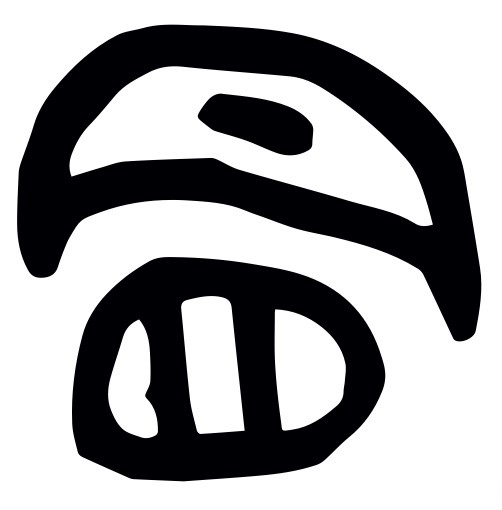
冒 in 冒险 means “disregard bad environment or danger……, withstand” though the origin of the character indicates nothing whatsoever of this sense: it’s merely an image of a hat.

The lower part is the eye ( the two vertical lines means two eyes) and the upper part the hat: to indicate that hat is the thing you see above a person’s eyes. The character for hat today, 帽 mào, still has this symbol in it, combined with another part 巾 jīn, cloth, which hat is normally made of.

The meaning of “risky and reckless” derived from this character perhaps comes from a Xiongnu leader’s name 冒顿 Modun, the Xiongnu sees their leader as “brave and daring”, and the Chinese conveniently (it’s said they fought numerous battles) translated it into “reckless and risky”.

So it’s no wonder 冒险 normally meets with disapproval among the Chinese.

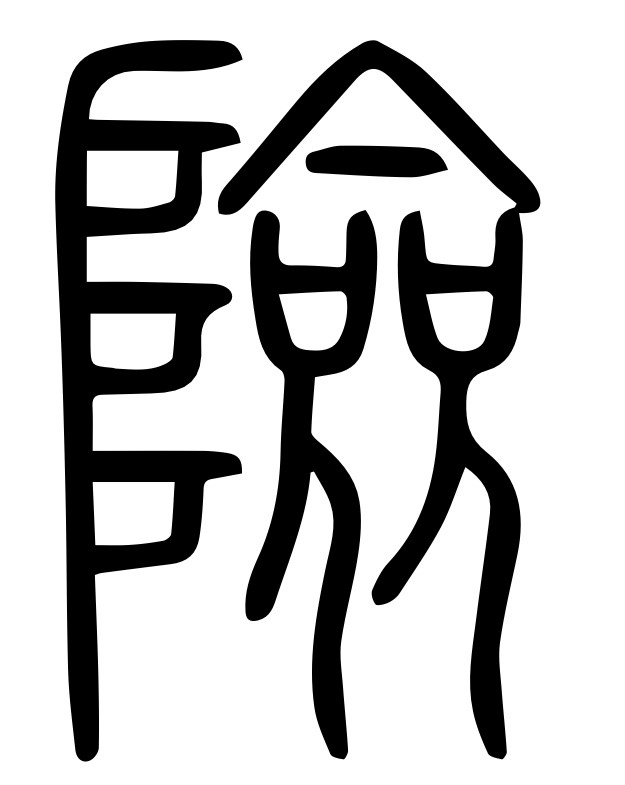
险 in 冒险, as the character generally means in its modern sense, means ‘danger, risk, hazard’. Though the character in its very beginning meant “a narrow pass, an obstruction, an impediment” as you will see in its ancient version:

The left part is the obstruction, the impediment, and the right part, under what looks like a tent or a roof, the two people are blocked by this confronting hindrance.

The Chinese has his reason to think twice when it comes to 冒险: as my apprehension grew, I feared and doubted my doings, and little by little, I led myself to a dark place filled with mistrust generated by fear and doubt.

Then, being, very proudly, a human, standing on his two legs and with a head to think and hands to do and mouth to speak and talk, you, human, stand up and turn the table around.

Apprehension, to apprehend, is also to lay hold of, to grasp and to learn.

I sit on, looking at the street with great shady trees and pink and blue and pale yellow three-storied buildings with bow windows that I have grown familiar with in the past few months, looking at the park across the street I daily visited. Goodbye, goodbye, it’s a goodbye day for me, and I am going……I am leaving……Just when I almost forget what I am waiting for. A message comes in to reassure me the acknowledgement of my arrival; a van slows itself down at my stairs and the man in it gives me an inquisitive look, and I nod to answer: Yes. It’s me! It’s me!

It’s me who is about to board an adventure.