The guy looks at me in such a way like I am asking him to cut off one of his arms, and I begin to think maybe it’s too big a favor to ask random people on the street.
Yet the urgency of it does not allow me to be scrupulous. And as the minute ticks, I grow more and more agitated. The second person I run into is a delivery guy waiting for his customer to come down and pick up the food, he too rejected me, though in a much roundabout and mild manner.
I now begin to feel like “热锅上的蚂蚁” (rè guō shàng de mǎyǐ): ants on a hot pan. Or the English choose to see a different animal: a cat on a hot bake-stone/ hot bricks/ a hot tin roof.
Urged by this matter that could not wait, and without knowing what to do or what I was doing, I walked on, crossed the street and went up to the park. As I walked up the hill, I quickly scanned all the park people lounging around–some by themselves, some with friends or family–and caculated my chances.
The girl looked up from her mat, took off her earphones and smiled at me in a pleasant, comforting way. I explained my situation in what must have appeared a very nervous manner. Though she wanted very much, she said, she could not, in this case, offer help. However, she reassured me: “No. I don’t think it’s too big a favor to ask at all. I’m sure many people wouldn’t mind the least.”
Being thus soothed, I walked around with a better heart. And the next one I asked–two girls sitting under a great tree in the summer evening sun talking and admiring the view beyond the river–met my agitation with cooling calmness, and, after my explanation, offered help without much ado and with a few good words.
In a few minutes, it was done. Though, the perturbation that had been accumulating in my body and mind in the past hour needs time to die down, and I was still in a state of strange excitement, and admittedly, I must have appeared strange. Again, these two girls, cool as cucumbers, imparted a few more good words before sending me on my way.
“仁rén” kindness, is said to be the core value of Confucius, and he explained 仁 in a few different ways:
樊迟问仁。子曰:“爱人”。——《论语·颜渊》: Fánchí wèn rén. Zǐ yuē:“Àirén”.
A follower, a student named Fánchí asks Confucius what is 仁,and Confucius says “Love people.”
So “仁者爱人rénzhě àirén”: he who is kind loves others.
Then being the wise man, Confucius explains it in a more elaborated way:
夫仁者,己欲立而立人,己欲达而达人。Fū rénzhě, jǐ yù lì érlì rén, jǐ yù dá ér dá rén.
The kind man, he wants to stand firm on his own feet, therefore he could help others to stand up; he wants to be prosperous himself, therefore he could help others to acchieve success.
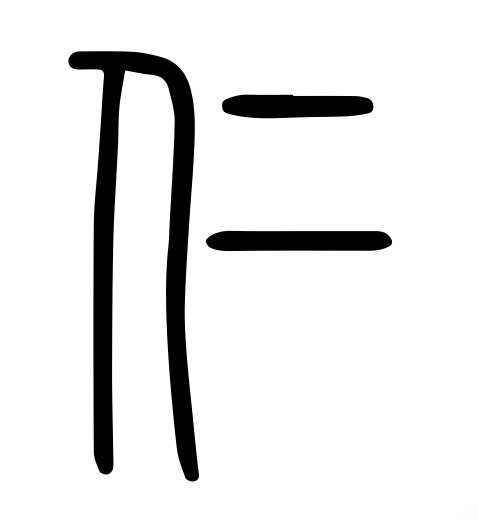
“仁rén”, the dictionary tells me, originally means “博爱 bó’ài: universal love, fraternity”. And the character today did not change much from the first version:
There is an ancient variant of 仁, kindness, which is interesting enough to be mentioned:
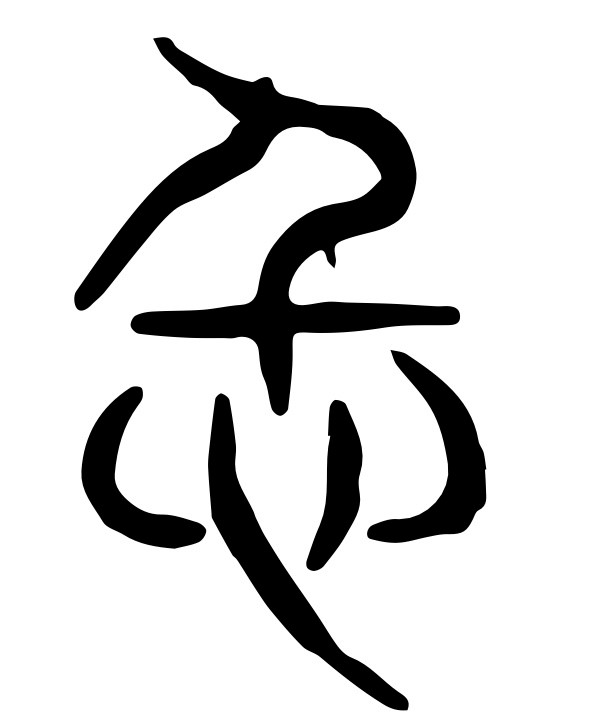
How nice it sounds! I could not help thinking, feeling all softened and warm, as I look at Kindness: it’s a thousand hearts.

 Learn Chinese with Me
You must be logged in to post a comment.