It’s said you use more parts of your brain when you learn Chinese. It’s said it is the most beautiful language in the world. It now becomes more and more popular, and to have Chinese Program in schools in New York is no longer uncommon. And I encounter more and more youngsters who are undaunted by what is the “traditional way of thinking”: that it is a very difficult language, indeed the most difficult language; that it is impossible to learn it; that it sounds strange and looks puzzling.
They start to speak, they speak on. They learn the first character, they go on writing thousands more. They make mistakes. They stumble. They laugh and they get on with it. And in the end, to my great delight and to theirs, I listen to them speak like a Chinese. I watch them write like a Chinese. And thus one of the world’s most important cultures opens to them; thus the doors of 1.3 billion people open to them–that’s not even including Japanese and Korean where they still use Chinese characters. (Indeed in ancient Japan and Korea, only the most learned people, the high officials, had the privilege to study Mandarin Chinese.)
Say philosophy is in the language. Say the language is how we name the world, perceive the world, express ourselves and communicate with others. And there is awful a lot you could learn the mind, the culture of Chinese people by learning its tongue.
Take the most basic characters for examples.
Take a moment to think. To think of humans. What is a human? If you have to draw–using the most economical way possible but at same time it has to convey your meaning–a symbol to mean human. What would you draw?
Would it be something like this?
Children often draw like this to mean a person, and Chinese too!
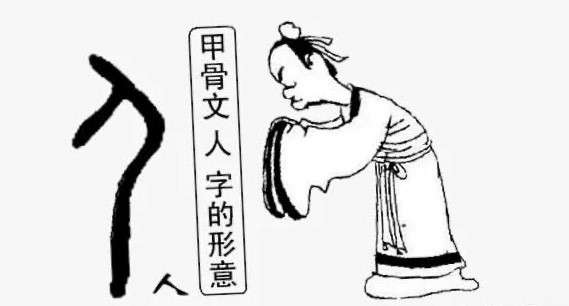
Here is how the Chinese character that means human came about:
He Knows His Manners!
And a very polite person indeed is he! (Guess where the custom of bowing in Japan comes from?)
And with time it evolves:
And now we use the last one to mean human which consists only two strokes.
So the courteous Chinese man looked into himself–human–and put down two strokes to mean a person. And in a way it also says the practicality of the Chinese!
—–more examples of Chinese Characters to be continued!
In this lesson we are going to learn how to say numbers in Mandarin and learn the basic strokes of characters to start us off on writing Chinese as well!
The Chinese way to count is easy enough, though in some ways it is very different from the western way to count.
Like other languages, we have a name for each number, from one to ten. Then for eleven we say “ten one”, twelve “ten two”, and so on. Twenty is “two ten”, thirty “three ten” and so on.
百 bǎi, hundred; 千 qiān, thousand, these are easy enough. Then comes the tricky part: we have a name for “ten thousand”: 万 wàn. We divide a big number by four digits instead of three. For example: we say 40,0000 instead of 400,000.
Now let’s learn the names of the numbers from one to ten:
一,二,三,四,五,六,七,八,九,十.
Yī, èr, sān, sì, wǔ, liù, qī, bā, jiǔ, shí.
Now let’s move on to the basic character strokes. Chinese symbols may at first look complicated and puzzling. But once you get to know the rules of how they are formed, they will begin to make sense to you.
There are eight basic strokes in Chinese character:
一 (横 héng): a horizontal line which is to write from left to right.
丨(竖 shù): a vertical line which is to write from up to down.
丿(撇 piě): the character 撇 which gives this stroke its name means to “throw away” and to “abandon”. It’s written from up right to down left.
㇏( 捺 nà): the character 捺 which gives this stroke its name means “to press down heavily with the fingers”. It’s the opposite of 丿, and is written from up left to down right.
㇀(提 tí): the character 提 which gives this stroke its name means “to lift”. It’s the only stroke which is written from down to up: down left to up right.
丶(点 diǎn) : the character 点 which gives this stroke its name means “dot, to point”. It’s opposite to ㇀ except being much smaller. It’s to write from up left to down right.
𠃋 (折 zhé): the character 折 which gives this stroke its name means “to break off, to bend”. It’s the combination of 撇 and 横 which is the reason that some textbooks names this stroke “撇横”.
亅 (钩 gōu): the character 钩 which gives this stroke its name means “hook”. The stroke looks like a 丨with a hook at the bottom, and in some textbooks it’s called “竖钩“. It’s to write first a 竖 (a vertical line from up to down), then at the end of the 竖 the pen goes up to the left and makes the hook.
These are the eight basic strokes of characters. No matter how complicated a character looks, it’s all formed by these eight strokes or a combination of them.
The general order to write a character is from left to right, from up to down; first 横 (一 ) then 竖 (丨), first 撇(丿), then 捺(㇏).
Now let’s learn to write Chinese numbers with the strokes we just learned.
一 (yī), which is basically one 横. It means “one” is self-evident.
二(èr), which is two 横: the first one or the upper one is shorter than the second one, or the lower one. It means “two” is also self-evident.
三(sān) which is three 横: the first two ones, or the upper two ones, are similar while the third one or the bottom one is longer. Yes. The Chinese draws three lines to mean “three”.
四( sì), is not four 横: they soon found out it’s not economical to keep on drawing lines. Still 四 looks a square and a square has four lines. The way to write this character which means “four” is to start from the left to write 竖 (丨); then there is a combined stroke of 横(一) and 竖(丨); then you write the inside first before close it off, so first 撇(丿), then there is a stroke which is the combination of 竖(丨) and a very short 横(一); in the end you close it with a 横(一). 四 is formed by five strokes.
五(wǔ), which means “five”, starts with a 横(一) on the top, then the 竖(丨) in the middle, the third stroke is 横(一) 竖(丨) in one, and the last is a 横(一) at the bottom. This character is formed by four strokes.
六 (liù), which means “six”, starts with a 丶(点 diǎn), then a 一 (横 héng), then a 丿(撇 piě), in the end a ㇏( 捺 nà).
七(qī), which means “seven”, has but two strokes. The first one is a 一 (横 héng), and the second one is 竖弯钩 (shù wān gōu) which literally means “vertical line, bend, hook”.
八 (bā), which means “eight”, is also formed by two strokes: a 丿(撇 piě) and a ㇏( 捺 nà).
九 (jiǔ), which means “nine”, has two strokes. The first one is a 丿(撇 piě), and the second one 横竖弯钩(héng shù wān gōu) which literally means “vertical line, horizontal line, bend, hook”.
十(shí), which means “ten”, also has two strokes: first a 一 (横 héng) then a 丨(竖 shù).
This ends the lesson. Now you are to be able to count and write from one to ten. And next time you see a character it should not look so alien and puzzling!
Here is an audio of counting one to a hundred in Mandarin Chinese:


 Learn Chinese with Me
You must be logged in to post a comment.