It’s All Chinese to Me

Draw it Out

—how were Chinese Characters created? Part One

So the courteous Chinese man, after taking his bow, went on looking into himself. He looks at his hand, his face, his eye, his nose, his mouth, his ear, his body, his heart and even his eyebrow: he is determined to know himself: a human.

And to the best of his ability, he draws out the part of himself he sees and examines.

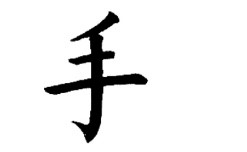
First the hand. How do you draw a hand? Everyone, in an idle minute, must have put their hand on a piece of paper and traced it. Indeed the very first pieces of arts we could trace are little hands imprinted on a rock:

Does not it look like so many humans, so many brave new people, in the very beginning of human race, in the most innocent and frank manner screaming out: I AM HERE! And ten thousand years later, we could still hear them!

The Chinese man looked at his hand and thought it’s a good idea to trace it too, only he did it in a slightly different manner:

And for a very long time, this image served as the symbol for the hand.

With time it evolves to:

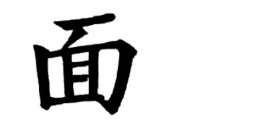
Next he went to a clear river and looked at his own face. He came up with images like these:
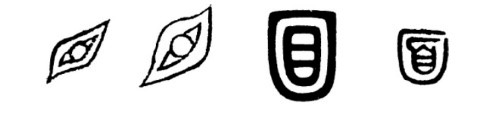
Being an abstract artist, at first he draws an eye, puts a frame around it to mean the whole face.

With time, it evolves into this:

Does not this woman’s face intimate the character?
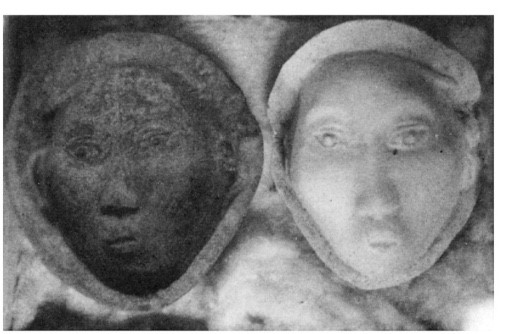
Or the face of this honest-looking, square-faced, big-eared man?
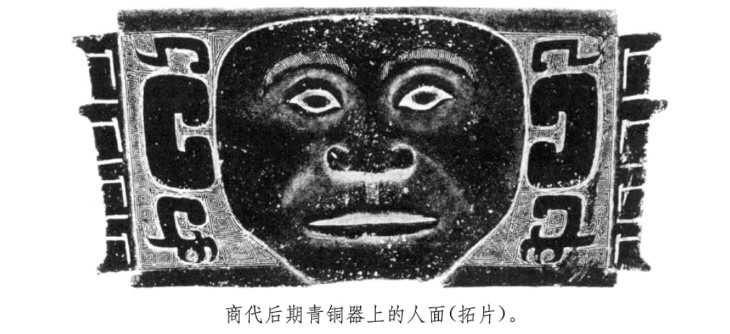
The Chinese man, after giving himself a good long look, went on looking up and down, right and left, till he draws out a picture for the sky, the sun, the moon, the tree, the fish, the ox…..indeed, he looks, he sees and he draws.

How many can you guess right? From left to right: moon, rain, mouth, ox, goat, wagon(car), boat, spring(water), melon.

So the Chinese man sticks to himself; so the Chinese man sticks to nature. There is no god in his thinking and there is no god in his drawing. There is, though, an infinite intimacy with the man himself, an infinite intimacy with all the things that are around him: nature, animals, all things living, all things he could see.

This is the character for sky. The Chinese man looks up and sees an enormous square, a roof above his head.

So we say the Chinese man has nature in his very blood and soul–there are thousands of poems and paintings to prove it. So we say there is a solid practicality in the craziest Chinese man: that man is part of nature; that man needs food; that food for every mouth means peace.
Magic it up

—-How Chinese Characters were created? Part Two

It all started with drawing. But there is only so much you could draw. Pretty soon, the Chinese man realized that he has to come up with other ways to make characters.

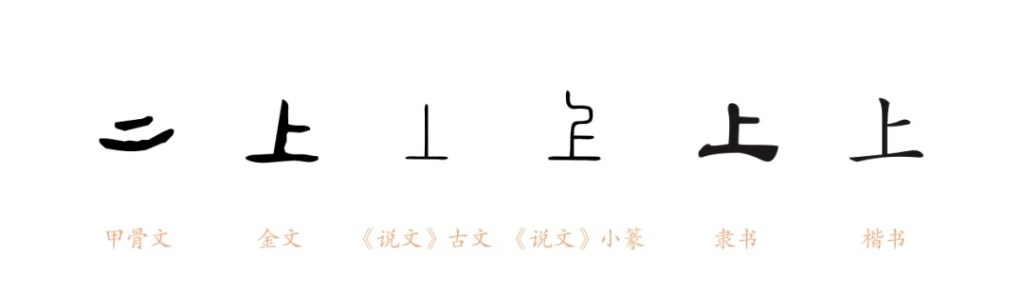
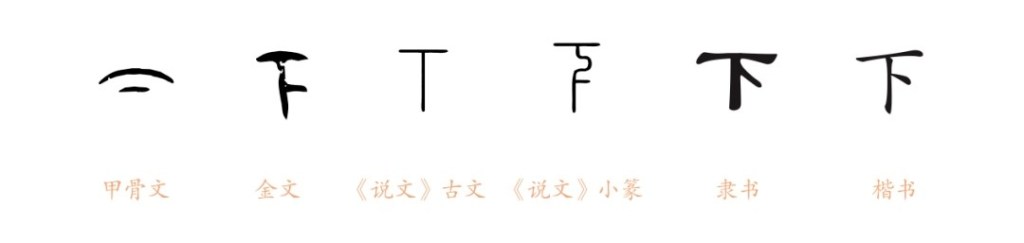
The first idea is easy enough: signs. Human knows how to use sign language long before they know how to speak, let alone to know the complicated system of written language. So when you point up it means up, and when you point down it means down.

So it’s not hard to tell it means “up”.
As it’s easy to tell this one means “down”.

But even with this brilliant idea, the Chinese man sees that there are still an awful amount of characters he needs to create.

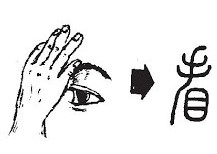
He thinks. He muses. He sighs. At last he sees before him, a man is putting a hand above his eyes, and even unconsciously, he looks at what that man is looking at, as if the man himself has told him “look!”

“Ah!” He thinks aloud. “I already have the character for ‘hand’ the character for ‘eyes’. If I put the hand above the eyes…..”

Do you still remember the symbol for “hand”?

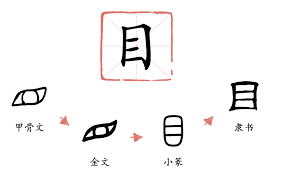
How about the drawing for “eyes”?

The arrows point out how it evolves.

So what about putting a hand above your eyes?

What are you looking for? Yes. That’s the character for “look”.

So with this method, he managed to make many more characters:

He sees one man at the heels of another man.

“That means ‘follow’.” he says to himself.

He sees the sun and he sees the full moon.

“One illuminates the day, the other the night. They are both bright.” He again muses to himself.

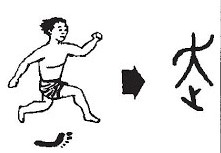
And a person waving his arms, with one foot on the ground, the other striding out means “walk”.

There is something joyful and vibrating in the character. For one could tell the walking man is cheerful.

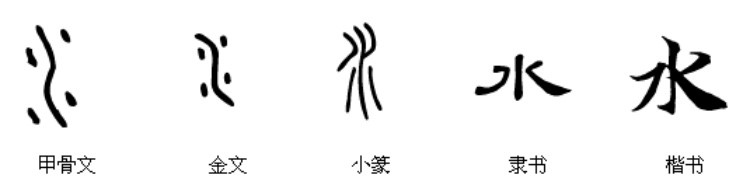
The close relationship between the Chinese and agriculture also shows in the characters, as words like “ox”, “goat” “pig” were the first created characters. So the concept that “the man begs food from the earth” was illustrated even in characters. As an inland country with a vast continent, the Chinese were not, roughly speaking, an ultra adventurous race: there was always land enough to plough and it never was worth one’s while to go to the sea and very likely get drowned. Even the word “water” is unlike the English word which shares the same root from “wave” of the sea. In Chinese the word “water”, instead of sea water, is from the river, and it flows with amazing tranquility and elegance.