Magic it up

—-How Chinese Characters were created? Part Two

It all started with drawing. But there is only so much you could draw. Pretty soon, the Chinese man realized that he has to come up with other ways to make characters.

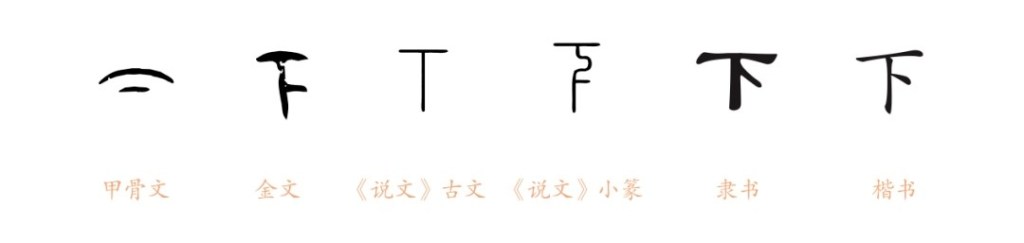
The first idea is easy enough: signs. Human knows how to use sign language long before they know how to speak, let alone to know the complicated system of written language. So when you point up it means up, and when you point down it means down.
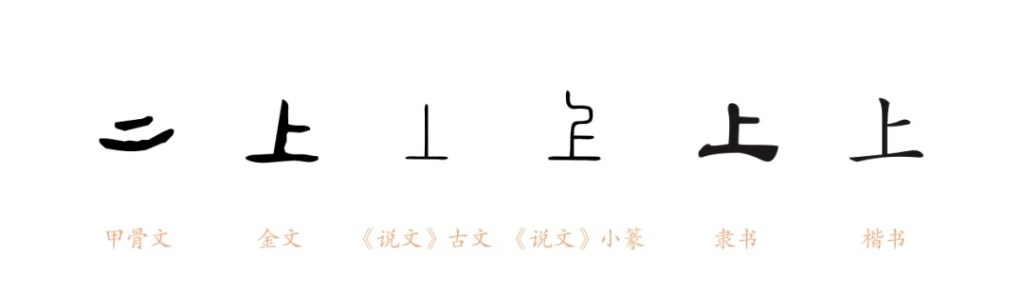
So it’s not hard to tell it means “up”.
As it’s easy to tell this one means “down”.

But even with this brilliant idea, the Chinese man sees that there are still an awful amount of characters he needs to create.

He thinks. He muses. He sighs. At last he sees before him, a man is putting a hand above his eyes, and even unconsciously, he looks at what that man is looking at, as if the man himself has told him “look!”

“Ah!” He thinks aloud. “I already have the character for ‘hand’ the character for ‘eyes’. If I put the hand above the eyes…..”

Do you still remember the symbol for “hand”?

How about the drawing for “eyes”?
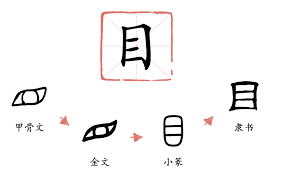
The arrows point out how it evolves.

So what about putting a hand above your eyes?
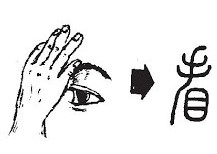
What are you looking for? Yes. That’s the character for “look”.

So with this method, he managed to make many more characters:

He sees one man at the heels of another man.

“That means ‘follow’.” he says to himself.

He sees the sun and he sees the full moon.

“One illuminates the day, the other the night. They are both bright.” He again muses to himself.

And a person waving his arms, with one foot on the ground, the other striding out means “walk”.
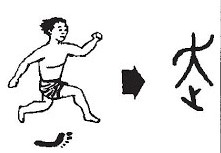
There is something joyful and vibrating in the character. For one could tell the walking man is cheerful.

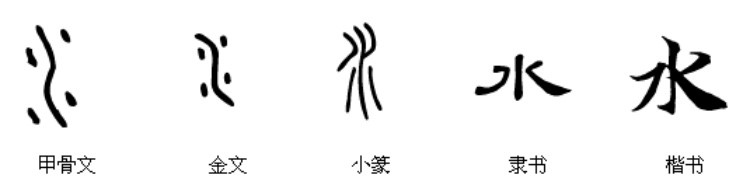
The close relationship between the Chinese and agriculture also shows in the characters, as words like “ox”, “goat” “pig” were the first created characters. So the concept that “the man begs food from the earth” was illustrated even in characters. As an inland country with a vast continent, the Chinese were not, roughly speaking, an ultra adventurous race: there was always land enough to plough and it never was worth one’s while to go to the sea and very likely get drowned. Even the word “water” is unlike the English word which shares the same root from “wave” of the sea. In Chinese the word “water”, instead of sea water, is from the river, and it flows with amazing tranquility and elegance.
Between Laughter and Tears

At times, it’s no use to tell them to do this or to do that: they would just insist on imitating what you are doing. As I looked at the little girl on the screen and sent her a “clapping hands” for her effort, her eyes lit up and she at once asked me in an eager tone “how do you do that?”

She then said to me what I just said to her “我给你 Wǒ gěi nǐ….”(I give you……) and sent over what she chose to click.

“他在哭还是在笑? Tā zài kū háishì zài xiào?” (Is he crying or laughing?) I looked at it and asked her.

“Well, those are happy tears, he is laughing.” The little girl informed her slow-witted elder.

A piece of news I read later told me that this now re-popularized emoji was actually chosen by Oxford Dictionary in 2015 as the word of the year. “For the first time ever, Oxford Dictionary has chosen a ‘pictograph’ as its word of the year. They say the ‘face with tears of joy emoji’ best represents ‘the ethos, mood and preoccupation of the year’.

It’s said this emoji has been extremely popular in China. And unsurprisingly, there is actually a Chinese idiom to echo this ‘pictograph’: 哭笑不得 kūxiàobùdé literally ‘cry laugh not get’: not to know whether to cry or laugh, both funny and extremely embarrassing, between laughter and tears.

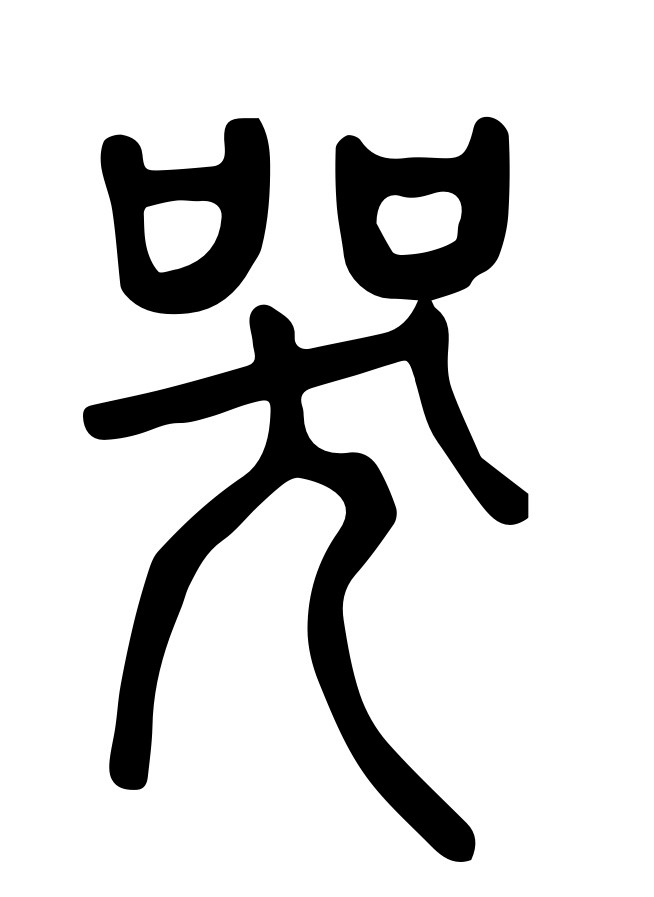
哭kū, to cry, at first sight it’s easy to mistake those two squares on the top for eyes and the dot below for the tear. Though the origin of this word comes not from the image of tears but from the sound of howling, the squares are not eyes but a wailing mouth:

The upper part actually is 口 kǒu, the bawling mouth, and the lower part is the image of a grief-stricken person who screams out his sorrow, he beats his chest, he stomps his feet.

The explanation of this character might, perhaps, remind you of a howling child you would occasionally see: they do bawl out in so loud and bitter a tone, waving their hands and stomping their feet in front of an–sometimes embarrassed, sometimes nonchalant–adult. And I often cannot help but look up amazed: what bitterness must inspire that hearty wailing? (Often, no doubt, it is small things like: he needs to go home to take his nap……)

At creating this character, the Chinese might have looked at the howling child, or he might have looked at an adult who is crying out his real woes:

The evolution of this character. The first one, you could see that the sad person opens his mouth big to cry, in the second one the mouths now are on the top and the person now has tears and grief-shaken legs, in the third one the person seems to be floored by the unbearable sorrow, and the fourth one is the one now we use today.

For the little girl–children, if you allowed them, have amazing ability to make up stories–it is happy tears, and who is to say it is not? And may we all in our long lives have more tears like those.

But what about yourself? What is a 哭笑不得 situation for you?