It’s a casual scene in a park: a woman gleefully ran to a poodle, squatted down in front of it, repeatedly kissed it, ruffled its hair and patted it in the most affectionate manner, all the while this quadruped stood mute and still, calmly taking on whatever the human wanted to do to him.
As I watched, I thought, it must be nice to inspire such ecstasy by merely showing yourself up. And I thought I would feel very good myself if someone was so very happy at the sight of me.
But what would I feel if some human, any human, chose to come on me like a mad thing and ruffle my hair all disheveled? Could I, like that poodle, take it on in so cool a manner?
Hm…..
As I stepped a bit further, I saw another dog coolly discharging his belly among all the passers-by and bustling in the park without the least shame.
Next to this dog in business, were a group of small children, two of them were standing very, very close–a closeness that would disquiet adults–and playing a game by pinching each other’s cheeks in turns, and after each pinch they poked into each other’s faces and examined the gradually disappearing redness the pinch had caused. They were so absorbed in the game and they were so close to each other that it’s evident they either forget themselves, or at that young age, very much like animals, they do not have a sense of self.
It is said that Eve was lounging about in the garden in the endless languid days until she ate the apple, then out she ejaculated : “Oh my God! I am naked!”
The English word “I” is related to Dutch ik and German ich, from an Indo-European root shared by Latin ego and Greek egō: a person’s sense of self-esteem and self-importance, a conscious thinking subject.
So to be I is to have privacy, to be I is to see and value yourself, and to be I is to think.
The Chinese character for “I”, 我wo3, was a lot more “down to earth” and practical: it comes from a weapon.
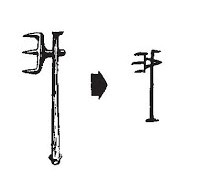
Indeed, to be oneself, to see oneself, is to stand out of a group and declare one’s difference, and to defend.
But by fighting for I, I could too lose the I, and in this way even violenting my own self, for my eyes, instead of opening to my own nakedness, instead of meditating, reflecting within, avert and fix on the others’ could-be-imagined hostility:

It moves on, and becomes this body awkwardly holds a weapon to declare himself:
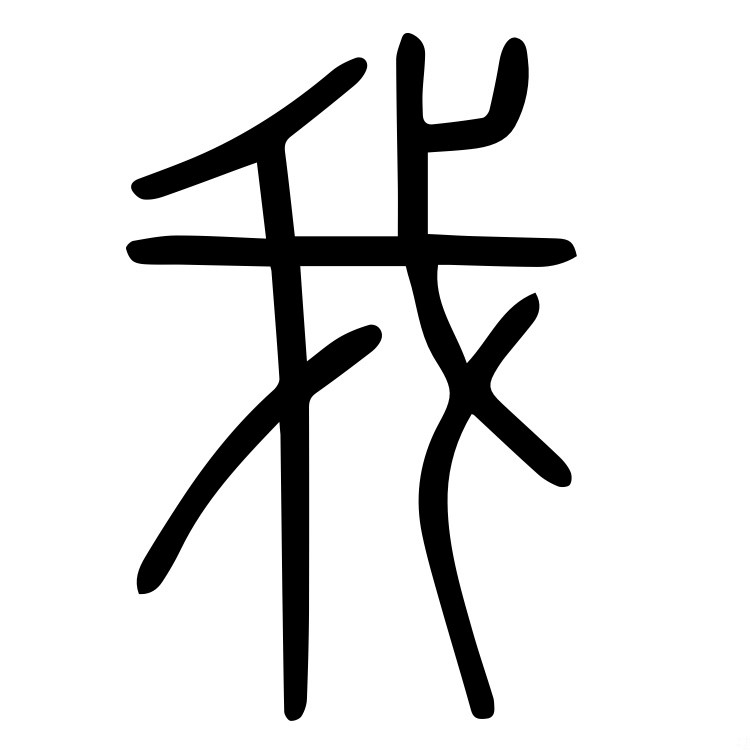
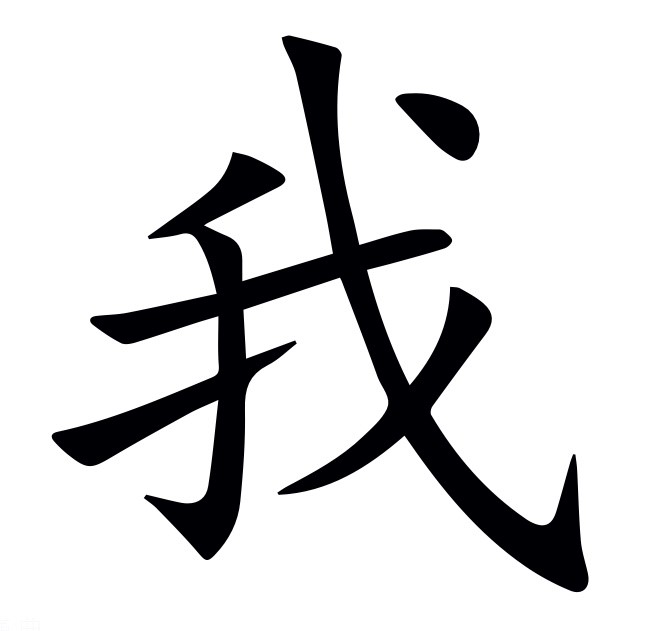
The character we use today 我wo3, evolves directly from this awkward soldier clasping a weapon.
Have we got the better bargain?
I mused.
Before “I“, there was no privacy, no knowledge, no shame and embarrassment about one’s nakedness.
After “I“, there is seeing, there is thinking, there is also, weapon and blood.
I would like to think we have, as long as we look within, living in the constant wonder of this complicated and strange being called “I“, and when by averting my eye to “others”, holding my ground, maintaining the “I”, but seeing not “the others” as element of erasing the “I”, but a different “I”, who, by the difference and contrast, helps instead of hinders for I to see my own self.
And I mused and walked on, got in a squirrel’s way, it retreated a few steps and let me pass: it might be an act of politeness. Or it’s because both the squirrel and the Chinese know this truth of living: to keep oneself and be oneself is no laughing matter.

 Learn Chinese with Me
You must be logged in to post a comment.