Magic it up

—-How Chinese Characters were created? Part Two

It all started with drawing. But there is only so much you could draw. Pretty soon, the Chinese man realized that he has to come up with other ways to make characters.

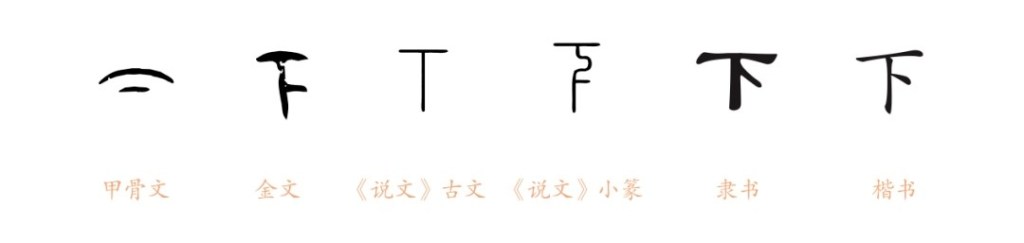
The first idea is easy enough: signs. Human knows how to use sign language long before they know how to speak, let alone to know the complicated system of written language. So when you point up it means up, and when you point down it means down.
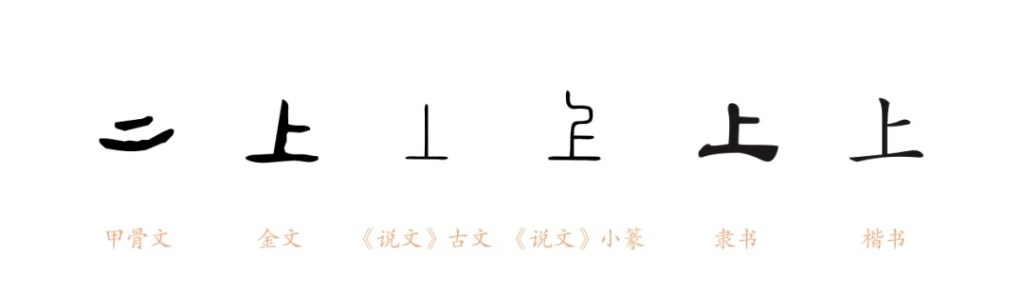
So it’s not hard to tell it means “up”.
As it’s easy to tell this one means “down”.

But even with this brilliant idea, the Chinese man sees that there are still an awful amount of characters he needs to create.

He thinks. He muses. He sighs. At last he sees before him, a man is putting a hand above his eyes, and even unconsciously, he looks at what that man is looking at, as if the man himself has told him “look!”

“Ah!” He thinks aloud. “I already have the character for ‘hand’ the character for ‘eyes’. If I put the hand above the eyes…..”

Do you still remember the symbol for “hand”?

How about the drawing for “eyes”?
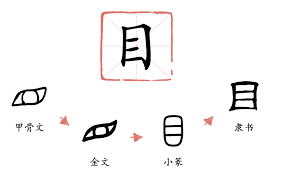
The arrows point out how it evolves.

So what about putting a hand above your eyes?
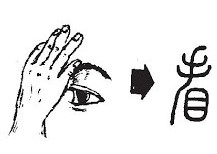
What are you looking for? Yes. That’s the character for “look”.

So with this method, he managed to make many more characters:

He sees one man at the heels of another man.

“That means ‘follow’.” he says to himself.

He sees the sun and he sees the full moon.

“One illuminates the day, the other the night. They are both bright.” He again muses to himself.

And a person waving his arms, with one foot on the ground, the other striding out means “walk”.
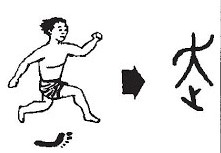
There is something joyful and vibrating in the character. For one could tell the walking man is cheerful.

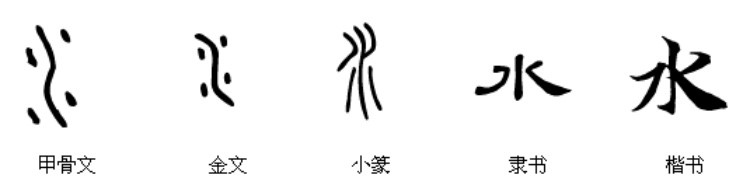
The close relationship between the Chinese and agriculture also shows in the characters, as words like “ox”, “goat” “pig” were the first created characters. So the concept that “the man begs food from the earth” was illustrated even in characters. As an inland country with a vast continent, the Chinese were not, roughly speaking, an ultra adventurous race: there was always land enough to plough and it never was worth one’s while to go to the sea and very likely get drowned. Even the word “water” is unlike the English word which shares the same root from “wave” of the sea. In Chinese the word “water”, instead of sea water, is from the river, and it flows with amazing tranquility and elegance.
Let’s Talk About Beauty

What do you think of beauty? What is beautiful for you?

If you could imagine, say, you were the very first human beings standing up straight on two legs and for the first time observing the primeval world, what would you think it’s beautiful among all the things you see?

The sky? The birds? The trees? The flowers?

For the English, for the Westerners, beauty is what is “good and fine”. The English word “beauty” comes from an old French word beaute which derives from the Latin word bellus that means “beautiful, fine”.

The Chinese though, have a very different way of thinking.

First, do we agree that life is difficult? Do we echo what Plato said thousands of years ago that “Be kind, for everyone you meet is fighting a hard battle” ?

Now think again! Those very first humans, standing awkwardly on their two newly erected legs in a brand new world; a world unknown to them; a world in which they have to forage and fight to meet their urgent wants.

So what would they think is beautiful when they are all hungry and cold?

The Chinese knows!

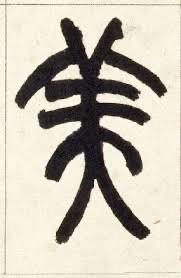
The Chinese word for beauty–美 mei3–explains it.

The upper part of the word means “sheep”, and the lower part means “big”.

So beauty for the Chinese is no more than a big fat sheep. Indeed when you are standing on your two just straightened-up legs shaking in the cold and hungry, what could be more beautiful than a big fat sheep that offers you food and gives you wool to protect you from cold?

It’s only when you are fed and warm, you have the mood to look at the woman sitting next to you gnawing the last bit of the lamb and thinking you are in your heart: This is another sort of beauty!

The word 好hao3, now means “good, healthy”, originally means “beautiful”, and what is beautiful?

The Chinese, of course, again knows!

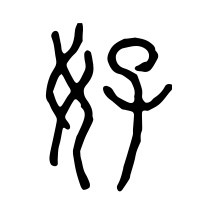
A woman! For the character explains itself: 女子nü3zi means “a woman”, and it looks like this in the beginning:

And yes, the woman, of course, like Madonna, is caring for a child: the left part is the woman and the right part the child.