It’s All Chinese to Me

—why you should learn Mandarin

It’s said you use more parts of your brain when you learn Chinese. It’s said it is the most beautiful language in the world. It now becomes more and more popular, and to have Chinese Program in schools in New York is no longer uncommon. And I encounter more and more youngsters who are undaunted by what is the “traditional way of thinking”: that it is a very difficult language, indeed the most difficult language; that it is impossible to learn it; that it sounds strange and looks puzzling.

They start to speak, they speak on. They learn the first character, they go on writing thousands more. They make mistakes. They stumble. They laugh and they get on with it. And in the end, to my great delight and to theirs, I listen to them speak like a Chinese. I watch them write like a Chinese. And thus one of the world’s most important cultures opens to them; thus the doors of 1.3 billion people open to them–that’s not even including Japanese and Korean where they still use Chinese characters. (Indeed in ancient Japan and Korea, only the most learned people, the high officials, had the privilege to study Mandarin Chinese.)

Say philosophy is in the language. Say the language is how we name the world, perceive the world, express ourselves and communicate with others. And there is awful a lot you could learn the mind, the culture of Chinese people by learning its tongue.

Take the most basic characters for examples.

Take a moment to think. To think of humans. What is a human? If you have to draw–using the most economical way possible but at same time it has to convey your meaning–a symbol to mean human. What would you draw?

Would it be something like this?

Children often draw like this to mean a person, and Chinese too!

Here is how the Chinese character that means human came about:
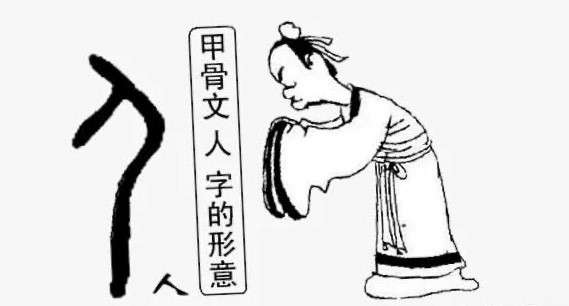
He Knows His Manners!

And a very polite person indeed is he! (Guess where the custom of bowing in Japan comes from?)

And with time it evolves:

And now we use the last one to mean human which consists only two strokes.

So the courteous Chinese man looked into himself–human–and put down two strokes to mean a person. And in a way it also says the practicality of the Chinese!

—–more examples of Chinese Characters to be continued!

Draw it Out

—how were Chinese Characters created? Part One

So the courteous Chinese man, after taking his bow, went on looking into himself. He looks at his hand, his face, his eye, his nose, his mouth, his ear, his body, his heart and even his eyebrow: he is determined to know himself: a human.

And to the best of his ability, he draws out the part of himself he sees and examines.

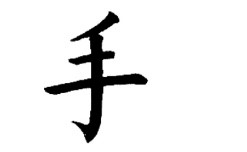
First the hand. How do you draw a hand? Everyone, in an idle minute, must have put their hand on a piece of paper and traced it. Indeed the very first pieces of arts we could trace are little hands imprinted on a rock:

Does not it look like so many humans, so many brave new people, in the very beginning of human race, in the most innocent and frank manner screaming out: I AM HERE! And ten thousand years later, we could still hear them!

The Chinese man looked at his hand and thought it’s a good idea to trace it too, only he did it in a slightly different manner:

And for a very long time, this image served as the symbol for the hand.

With time it evolves to:

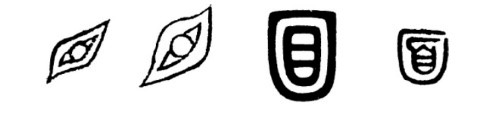
Next he went to a clear river and looked at his own face. He came up with images like these:

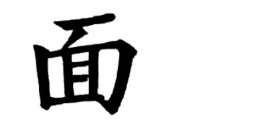
Being an abstract artist, at first he draws an eye, puts a frame around it to mean the whole face.

With time, it evolves into this:

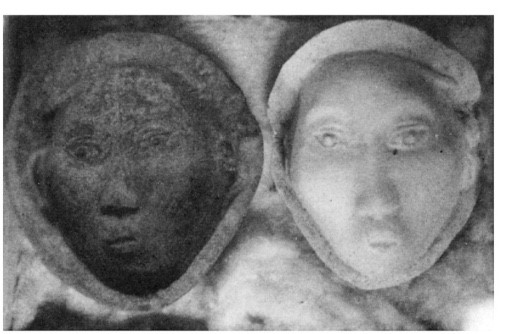
Does not this woman’s face intimate the character?

Or the face of this honest-looking, square-faced, big-eared man?

The Chinese man, after giving himself a good long look, went on looking up and down, right and left, till he draws out a picture for the sky, the sun, the moon, the tree, the fish, the ox…..indeed, he looks, he sees and he draws.

How many can you guess right? From left to right: moon, rain, mouth, ox, goat, wagon(car), boat, spring(water), melon.

So the Chinese man sticks to himself; so the Chinese man sticks to nature. There is no god in his thinking and there is no god in his drawing. There is, though, an infinite intimacy with the man himself, an infinite intimacy with all the things that are around him: nature, animals, all things living, all things he could see.

This is the character for sky. The Chinese man looks up and sees an enormous square, a roof above his head.

So we say the Chinese man has nature in his very blood and soul–there are thousands of poems and paintings to prove it. So we say there is a solid practicality in the craziest Chinese man: that man is part of nature; that man needs food; that food for every mouth means peace.