Magic it up

—-How Chinese Characters were created? Part Two

It all started with drawing. But there is only so much you could draw. Pretty soon, the Chinese man realized that he has to come up with other ways to make characters.

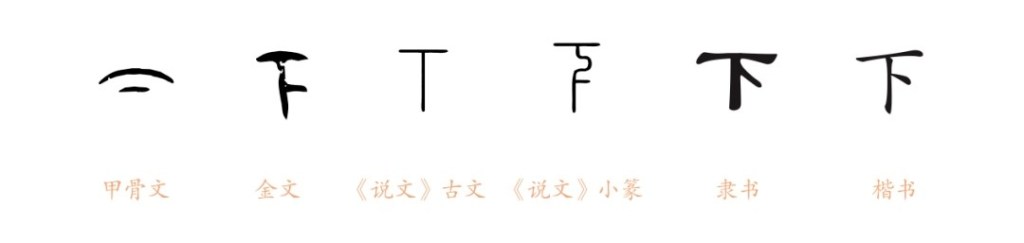
The first idea is easy enough: signs. Human knows how to use sign language long before they know how to speak, let alone to know the complicated system of written language. So when you point up it means up, and when you point down it means down.
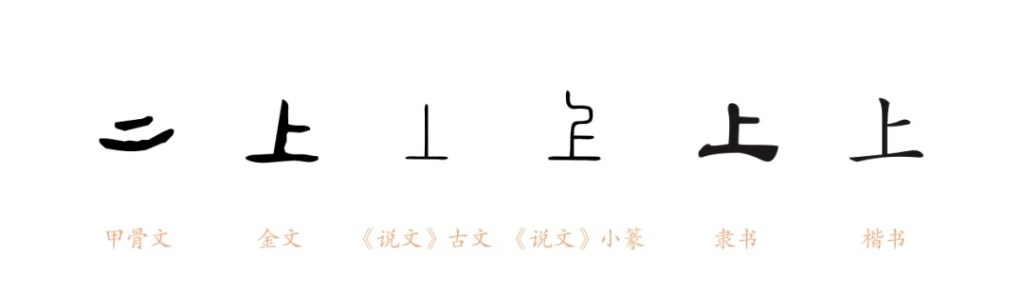
So it’s not hard to tell it means “up”.
As it’s easy to tell this one means “down”.

But even with this brilliant idea, the Chinese man sees that there are still an awful amount of characters he needs to create.

He thinks. He muses. He sighs. At last he sees before him, a man is putting a hand above his eyes, and even unconsciously, he looks at what that man is looking at, as if the man himself has told him “look!”

“Ah!” He thinks aloud. “I already have the character for ‘hand’ the character for ‘eyes’. If I put the hand above the eyes…..”

Do you still remember the symbol for “hand”?

How about the drawing for “eyes”?
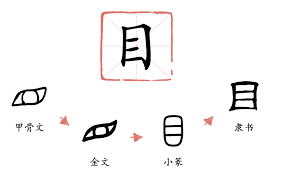
The arrows point out how it evolves.

So what about putting a hand above your eyes?
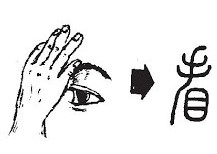
What are you looking for? Yes. That’s the character for “look”.

So with this method, he managed to make many more characters:

He sees one man at the heels of another man.

“That means ‘follow’.” he says to himself.

He sees the sun and he sees the full moon.

“One illuminates the day, the other the night. They are both bright.” He again muses to himself.

And a person waving his arms, with one foot on the ground, the other striding out means “walk”.
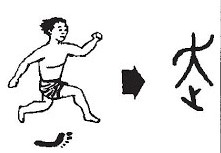
There is something joyful and vibrating in the character. For one could tell the walking man is cheerful.

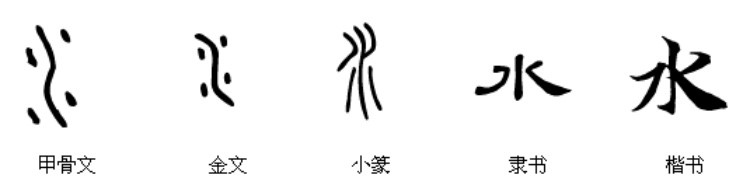
The close relationship between the Chinese and agriculture also shows in the characters, as words like “ox”, “goat” “pig” were the first created characters. So the concept that “the man begs food from the earth” was illustrated even in characters. As an inland country with a vast continent, the Chinese were not, roughly speaking, an ultra adventurous race: there was always land enough to plough and it never was worth one’s while to go to the sea and very likely get drowned. Even the word “water” is unlike the English word which shares the same root from “wave” of the sea. In Chinese the word “water”, instead of sea water, is from the river, and it flows with amazing tranquility and elegance.
Speak to Me

“Put me down!” The little tyrant demanded in her small voice, kicking her tiny legs– indeed cute as a little daisy she was, and looked no more than three years old. The dad–giant he looked in contrast with the infantile figure–set the tyrant on the ground with nervous haste: you could tell, from his clumsy movements and his uneasiness, that he must be a first timer, and did not yet quite know how to best serve his little daisy.

Now the balloon on the stroller somehow untangled itself and threatened to flee, the dad caught it just in time, but the little tyrant snatched the string from the giant’s hand. Out she spoke: “My balloon!” Then she emphasized: “Mine!” And off she carried her treasure and out she strode in mighty steps in front of the giant her slave.

Words must be a kind of magic for children when they are learning language: you say a thing, and it’s done; you claim a thing, and it’s yours. You could direct and demand and assert by simply opening your mouth and utterring some sounds.

Next to the striding little daisy with her smiley face of a red balloon, were two dogs sniffing each other, then all of sudden, upon some sign only they themselves could sense, amity turned into enmity, and they started barking. The two owners, while pulling the leashes and trying to calm their dogs down, greeted each other good morning and talked about the weather:

“It’s so humid!”

“I know! It’s awful! It’s been humid this whole summer!”

While the dogs could only bark, their owners–human–could make a lot more complicated sounds that they call language. And without knowing it or much thinking about it, these two humans followed a few principles of communication: they exchanged information, they cooperated with each other, and even in so small a talk–only two lines indeed before they passed out of each other’s way–there was a sense of mutual goodwill.

It sets you wondering what is the very first sound, the very first word, human made that could be called language–it is, when you think about it, not surprising that in almost every language the word for mother sounds similar: mama. There must be a long period of barking, hissing, granting, roaring, piping…before humans could express themselves properly.

And the need must be the drive behind it. The little girl commanded “put me down” for her desire, perhaps, to walk by herself. And in the very beginning of human existence, it must be the need to exchange information that sets off the creating of language. At last they could say to each other: the pond on the north has more fish in it, and tomorrow there is a storm coming you’d better shelter yourself.

“Language learning is both socially motivated and socially constructed.” Said an eminent language teacher. “Looking for ways of exploiting the learning opportunities offered by the raw materials of the classroom, that is the language that emerges from the needs, interests, concerns and desires of the people(the students) in the room.”

This concept also concers with a language learning method developed in the 1950s: PPP which stands for Presentation, Practice and Production.

Which basically, if I could use learning to ride a bike as a metaphor (after all, learning languages and learning to ride a bike have some similarities: it’s a skill, and when you learn a skill, you need to practice, practice, practice), means I (the teacher) show you how to ride a bike, you( the student) imitate a few times what I just showed you, then you(the student) are put out on the road( the real situation) to ride the bike with the skill you just learned while I (the teacher) guide and correct and help to improve.

And ideally the Production part–the stage you are put out on the road–should be by far the largest part of the lesson, which means you have to swim to learn to swim. And you have to speak to learn to speak.

So we could begin with a new word, we could warm up by making a few sentences with this new word, then maybe you could start really speaking to me, say something you really want to express, something that you are dying to tell, some information you have to pass on, some emotions you must vent…… Speak to me.