What Does the Fox Say?

We were learning animal names, and the little boy, eagerly pressing down the dog button, said “woof, woof, woof.”

It, admittedly, was not the first time I learned animals with small children, and nor it was the first time I heard “woof” from the small mouth of a prattling child. Still, it brings a smile to my face every time I hear it.

I remember, in wonder when first arrived in northern Europe, Sweden, I listened to their strange talk, for me it sounded somehow like knocks on the wood, and it suited, in my mind, the cool, crisp northern air came in to my nose and the clear, blue northern sky that came in to my eye. And when they in groups, and with much vigor, roaring out “Ya! Ya! Ya!”, they seemed to me so many vikings fresh out of their boat.

The locality, the enviroment we live in must have such profound influences on our tongues that the mountains, the oceans and the air seem to shape the voice we utter to fit in its landscape.

China boasts a vast territory and a wide geographical span (地大物博dìdàwùbó). It covers almost all terrains, from high towering moutains to deep flowing rivers. And, perhaps in an effort to echo this variety, tones are developed in its language, the bright sound and sonorous intonations go up and down, full of changes. The syllables, well-defined and limited, are normally short and clear, and it’s said these phonetics characteristics make the language sound melodious and full of music.

The dog, be it comes from China or America, of course, says the same thing, it’s only we interpret it differently.

So while the American says their dogs bark “woof”, the Chinese hears theirs howl out a clear and short: “Wang! Wang! Wang!” (狗gǒu,汪!汪!汪!)

And they hear the cat calls out “Miao! Miao! Miao!” (猫māo,喵!喵!喵!)

Duck goes “Ga! Ga! Ga! ( 鸭yā,嘎!嘎!嘎!)

Bird goes “Ji! Ji! Ji!” (鸟niǎo, 叽!叽!叽!)

……

“The names we give animal sounds are not straight-up imitations of those sounds. They are interpretations of those sounds, filtered through phonemes of a given language.” So the internet tells me.

Each language’s interpretation may be different, there is, however, something in common, we being human, and being naturally anthropocentric, think the animals say the language we choose to speak and hear, and think also, with much arrogance, that we could stand apart and impose on Nature without seeing that we are in it, we are part of it, and the influences and the communications are in both ways.
On Time

Three green benches in a row appeared into view, all unoccupied. I halted, gazed and considered. The early morning sun was still low behind some buildings, and all the three benches were in shade. I eventually chose the one on the side next to a cluster of bushes that promised the most privacy as much as an open space in a park could render. I then opened my book and presently was absorbed into another world.

Though the present world before long called me back. As I looked up from the pages, I saw that the sun now had risen high behind some tall trees, the spot I sat on was now in its white light, the heat had been accumulating, and now reached to an unpleasant degree. I accordingly moved, and in the course of the morning, I moved once and again from one bench to another as the sun moved and put now this bench in shade, now that.

The Chinese, from the very beginning, knows that time is about the movement of the sun. They put a sun 日rì in the character ‘time’ 时shí.

And it’s a pleasure to think that the Chinese tells time this way: they must have stood under the sky, gazed long and considered hard at the sun to be able to tell the precise time.

Indeed the character explains itself this way: 时shí, the left part is the sun 日 rì and the right part is a length unit 寸cùn.

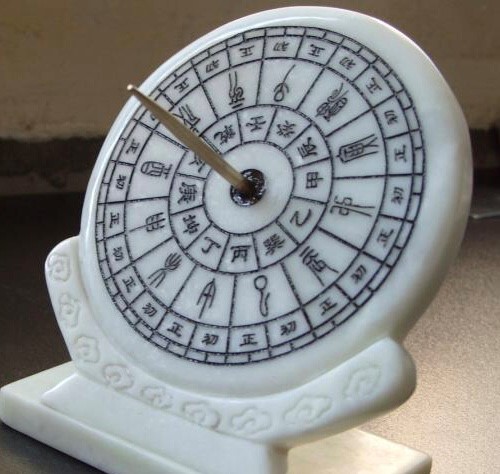
Of course they made a 日晷 rìguǐ after all the gazing and considering and calculating:

Time, in this case, would be told by the sun which casts a shadow of the stick in the middle upon the disc around it.

But the character 时 in its origin means not the time, the hour, the moment as it means now, but the four seasons ( Is this the reason that 时 sounds very similar to 四 sì four?). Though, despise the variation of meanings, the character from the start never deviated from the sun.

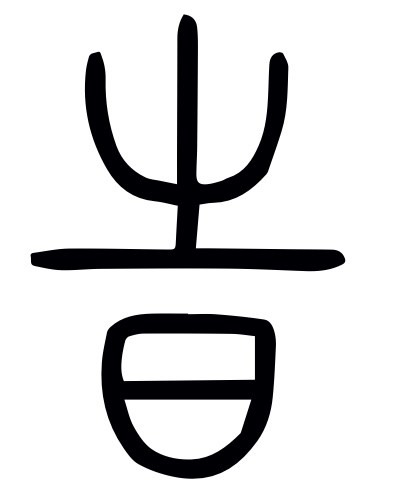
The upper part 出 chū means “out, coming out” from the image of grass coming out from the earth, and the lower part is the sun 日 . And the character that now means ‘time’ in the very beginning literally means: Here Comes the Sun.

Later on ( though not much later, still far, far back from recent) the Chinese adds another character to mean time 间 jiān, and till today 时间 shíjiān still means ‘time’.

间 , as I look it up in the dictionary, proves to be a character that delights and worth much noticing: it all comes from a crack and the moon!

夫門夜閉,閉而見月光,是有閒 隙也 fū mén yè bì, bì ér jiàn yuèguāng, shì yǒu jiànxì yě: the dictionary thus explains the character: the man closes the door at night, though it’s closed he still sees moonlight comes in, it is because there is a crack(How delightful! They could make a character out of this!) And indeed, this character, the outer part is the door 門 or 门 mén (I do hope you would think it does look like a door.) and the inner part is the moon 月 yuè.

And this crack 间 went on becoming bigger and more important and now it means ‘time and space’.

Now the Chinese from the very beginning knows time is about the sun, about the movement of the sun: it moves a certain space in the sky and indicates a certain length of time. And not long after that–as astonishing as it sounds–they also figured out what Einstein would explain about two thousand years later in a more elaborated way that time is space, and that’s still how the Chinese interprets time today 时间, time and space are one (Yes. We certainly are an astonishingly smart race! Well, at times!)

So when the Westerners gaze at the sea to watch the tide–the English word ‘time’ comes from ‘tide’, the Chinese, being mostly inlanders, watches the sun moves across the sky, the four seasons come and go, the moonlight comes in through the crack, and says: “一寸光阴一寸金,寸金难买寸光阴 yī cùn guāng yīn yī cùn jīn, cùn jīn nán mǎi cùn guāng yīn“.