Buy, Buy, Buy

As I am walking on a sunny May day–the sort of day that makes you believe you will find happiness around the corner–I see a long queue outside of a sports store–I scrutinized, as well as I could while fast walking, everyone in the line. “All of them want something sporty, and all of them got money to buy it.” I thought to myself–for it is an expensive brand.

A block further, a sign board in front of another sports store, more expensive still, says it offers “Groundbreaking Spring Sweatpants”. As I hastily glanced in, I see that it has attracted a crowd.

Hours later, it’s my turn, in a noiser and more packed area, to be the buyer.

The busyness of the street, the passing crowd, loudly and continuously reminds me of a new reality which makes quite a contrast with the year-long silence and stillness: there is a relief and long-repressed liveliness in the bustle, and you feel New York is New York still.

The Chinese word for buy “买mǎi”, it’s said in the dictionary, originally means “to market, to trade” and the word for market “市shì“ in Chinese is the same word for city.

And if you, indeed in the middle of any city, looked around, you would see that the Chinese has a good reason to make these two words one.

And in the very, very beginning–when they still had to find a sharp flint to scratch the character on a piece of bone–there was only the word “买 mǎi”: to buy; and not the word “卖mài“: to sell.

At that time, 买 mǎi also had a different sense of “buying” than we think of today: mainly as individual customers. Back then, it meant more like a merchant (the word “merchant” which shares the same root with “market” —mercari, to buy–might be said the more accurate equivalent to the Chinese character 买), it meant more like a merchant who ‘nets in’, who purchases goods and properties to gain profit. And the Chinese word for monopoly “垄断lǒngduàn” which came to existence about two thousand and five hundred years ago, the original sense is “ridge in field” — and that, as strange as it sounds, could be easily explained: the merchant climbs up to the highest point of the filed near the trading place to have an overview of the market so to “net in” all the profit he could get.

And it really is a real net:

The very first symbol–on the right side–they scratched on the bone comes directly from a real net–see the left side–and the coveted goods or money : the lower part of both sides: the seashell which was used as money at that time.

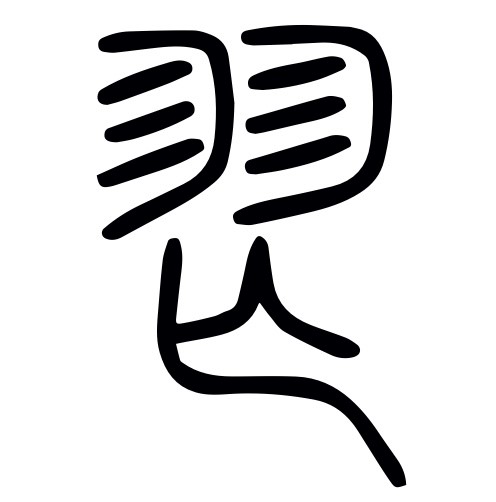
And a thousand or two years later, it became this:

The net on the top is still very much like a net, the seashell on the bottom very much like a seashell.

And who says human evolves and becomes wiser, surely the buyers nowadays fritter their money away while the buyers (and certainly the same sort are still here today and becomes bigger and stronger and globalised: they no longer stand on the ‘ridge of field’, but the ‘ridge of the world’), while the buyers then “net the seashells in”.

Well, well, methinks we should find that ridge.
Let’s Dance

Every morning, if the weather permits, in the park there are, sometimes one, sometimes two or three groups of middle-aged Chinese women dancing, it’s not a very inspiring scene for me: the music is almost always sugary, and their moves, to say the least, amateur. (What drew me to New York was the Broadway dancing I encountered in a summer in Bryant Park years ago, and that’s something excites and amazes me still: the bold confidence to claim your stage in the world.)

And yet, there is a plain honesty in the groups of women in the park: they gather together from all walks of life, one might be a waitress works hard work to bring on the table the plate of food you ordered, another stands behind a counter in a 99 cents store for many hours a day……yes, there is a slovenliness in their appearance: they could hardly afford to be otherwise, still, they come and they dance, in the mid of the hard struggle of life, dancing to the sugary music about love.

And isn’t it always nice to see a group of women dancing in the park? It says an attitude toward life.

There is a Chinese idiom: 手舞足蹈 shǒu wǔ zú dǎo which, if literally translated, means hands waving feet jumping, it describes a person, when encounters extreme excitement or happiness, couldn’t not help himself but dancing: does it remind you of how children act when they are given unexpected presents, a puppy for instance?

Say, in the very beginning, nature’s hostility–“the heat of the sun, the furious winter’s rage”–must be a lot more fearful for the unequipped and vulnerable human race. Hard work it must be to get food for your belly. Imagine that you are always on the go, moving from one place to another in search of food, you could hunt, fruitlessly, for days. Then all of sudden, out the arrow shot, down fell the bull. What extreme happiness must that be? Could you picture that hunter “hands waving feet jumping”?

In Chinese culture too, the word dance 舞 wǔ, comes from sacrifice, a ritual slaughter. The Chinese too, after shooting down the bull, could not believe that it’s his own strength that did it. It must be the scary and all mighty one who lives up in the sky, he says to himself, who can throw thunder and raise winds if he is angry. To pacify the mighty one’s anger and gain his favor, human offers Him the meat of the bull, and with its long tail, human dances a joyful dance for the one watches from the sky.

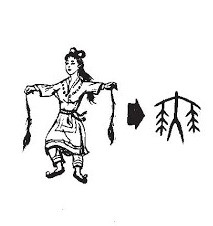
This woman here with two bull tails in hands stretches out her arms and moves her feet which becomes the first symbol for dancing: the image on the right side.

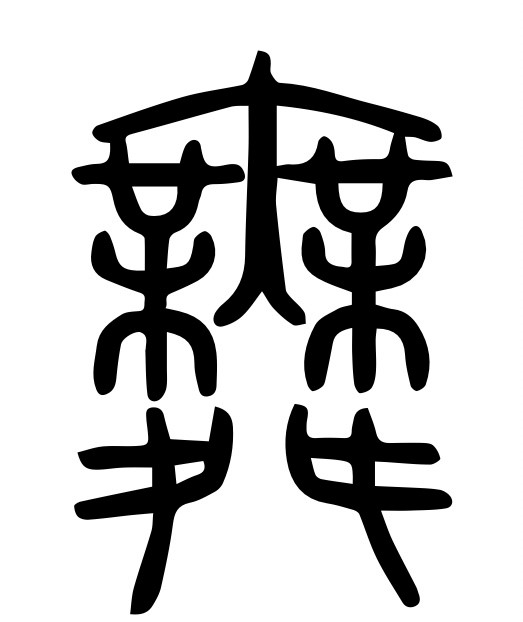
For a time it went to a variation of feathering dancing: when you decorate your head with feathers. Indeed, the dancing women in the park illustrate this feature by, sometimes, waving very colorful fans.

The upper part is the feathers, and the lower part the feet.

Then it again went back to its origin–a person, arms stretching out, holds bull tails in both hands:

The upper part is the person holding, now more elaborated, tails, the lower part is the two feet going to opposite directions: to imply that he does not walk but dances.

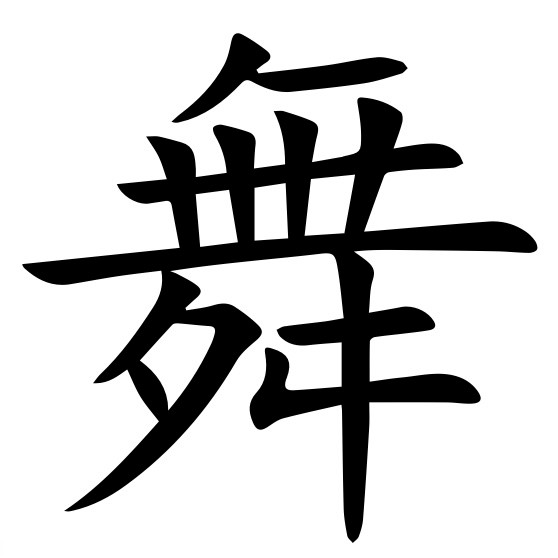
This is the character we use today:

The person is simplified into the two strokes on the top, the tails becomes the sticks-looking thing in the middle, and the feet on the lower part, through your one foot looks very much like the other, now are two very different symbols that means two feet go opposite directions.

I would like to think that the first Chinese man, at finally shooting down the bull, with the thought that his food, his immediate want now is secured and could be satisfied, could not, in his extreme happiness, resist waving his hands and jumping his feet, has something very similar with the women dancing in the park: they both celebrate life.