Spring!

The luxuriant grass, new and tender, bends softly under my foot, it cushions my every step.

“It is now spring! I come out! I meet the sun! I grow!” They seem to be declaring, with exuberance, in their green voice.

It is a feast to the eye too to behold these leaves of grass, this greenery, it softens and gladdens my heart. It puts a spring in my step.

They are not the only ones that come out in this springtime. The sun has drawn out new leaves in every tree, flowers too appear, unexpected, everywhere, delights the eyes of passers-by.

“Ah! It is Spring!” Said I softly to myself. “She has come!”

There is a brighter light at dawn. The sun comes out earlier every day. I could tell it by the chirping of the birds at my window. Each day they celebrate the arriving of the sun by singing.

And it departs later every evening. It seems to be courting his mistress Spring.

The golden-red glow is still high on the west when it’s way past dinner time. In this soft twilight, the most romantic hour of the day, in this caressing warmth, the most romantic season of the year, lovers appear on the lawn, on the benches, content themselves with low whispering.

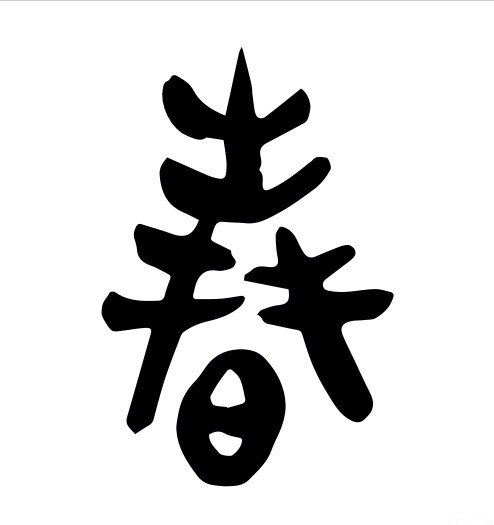
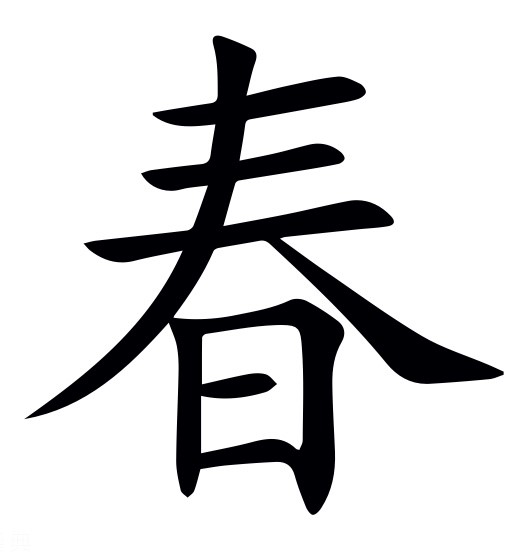
So spring is growth, it is the coming out of the grass, it is the longer stay of the sun. And the Chinese wakes up to an earlier, a brighter dawn, ears filled with the twittering of the birds, and eyes, behold, with delight and astonishment, the tender grass coming out of the earth, and he says: CHUN1, 春。It sounds, not by coincidence, very much like the Chinese word for ‘coming out’ CHU1 出。
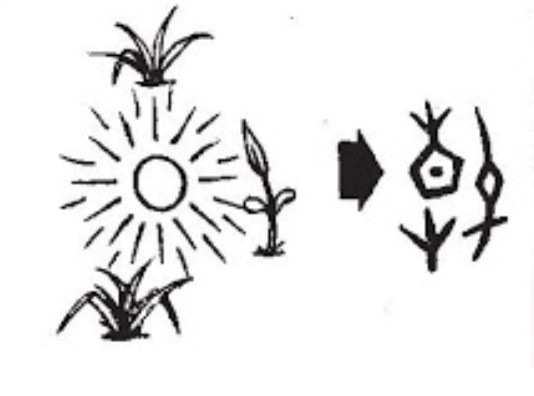
The sun and the grass make a spring!
You could still see the grass on the top and the sun at the bottom.
At some point in the evolution of characters, it becomes this, and it looks very much like the one we use today!
This is the one we use today, if it’s no longer easy to tell the grass, the sun is obvious enough: we still use the lower part: 日ri4, for the symbol of the sun.

The Guest

It is said in the dictionary that the English word “guest” comes from Middle English: from Old Norse gestr, of Germanic origin; related to Dutch gast and German Gast, from an Indo-European root shared by Latin hostis ‘enemy’ (originally ‘stranger’).

Is it surprising that it shared the same root with “enemy” and “stranger”?

We call human “the host”, and in this case, this host’s guest, the virus, indeed is an enemy that, sometimes, claims the life of the guest.

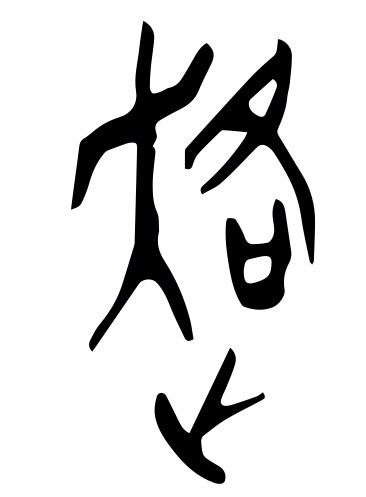
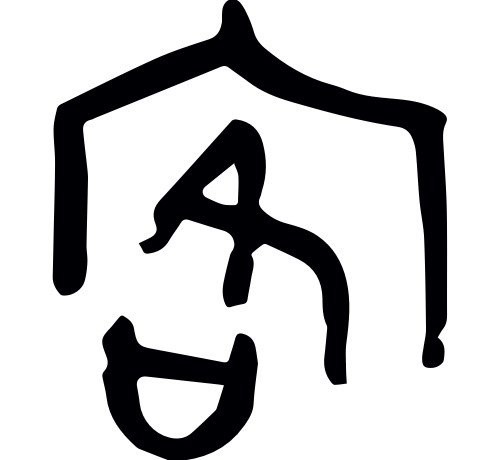
The Chinese character, 客 ke4, original means the person who travels to a strange place, to a foreign country, the person who lives away from home.

And the lower part of the character tells the travelling man finally stops:

On the left you could see the buoyant travelling man swinging his arms and stretching his legs, and the right part indicates he has come to his journey’s end.

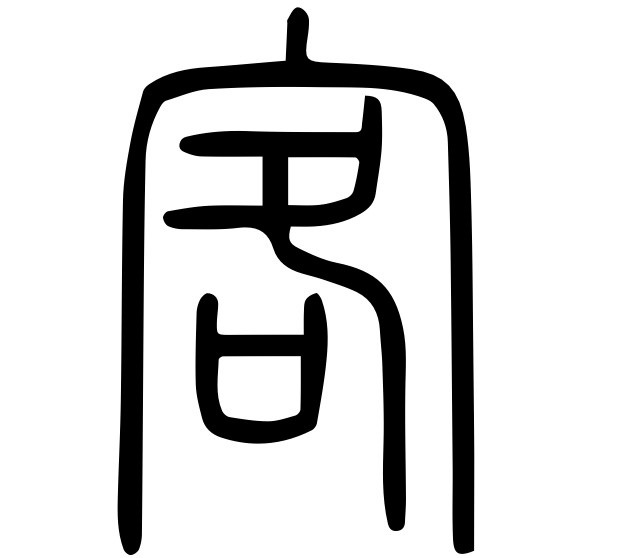
Later it evolves into this sign and it becomes less easy to tell the origin:

The upper part here is the traveller, and the lower part implies the stop.

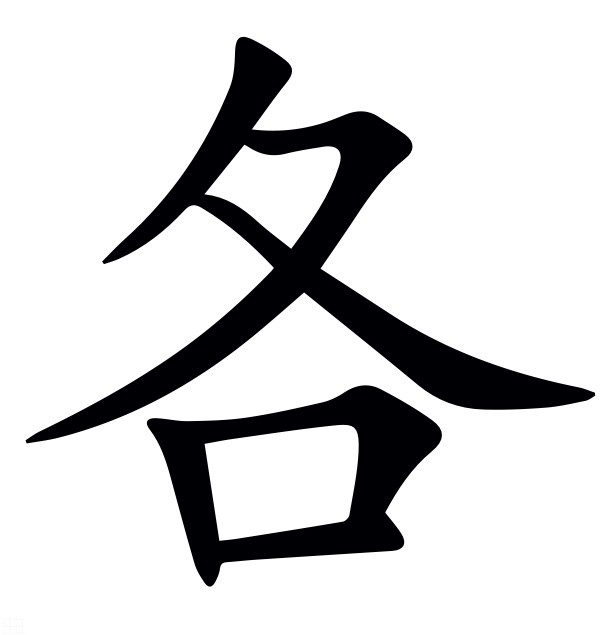
It eventually becomes the symbol we still use today which forms the lower part of the character 客 ke5, guest:

And it has long lost its original meaning: the stopping traveller.

The other part, the upper part, of 客 ke4, guest, is simple enough: it’s a roof. This travelling man stops and comes to your roof to stay:

it’s plain enough to see the house and the guest under it.

Hundreds of years later, the Chinese decided there was a less difficult way to describe the guest:

There is indeed a flow, an easy elegance and a solidity in this guest.

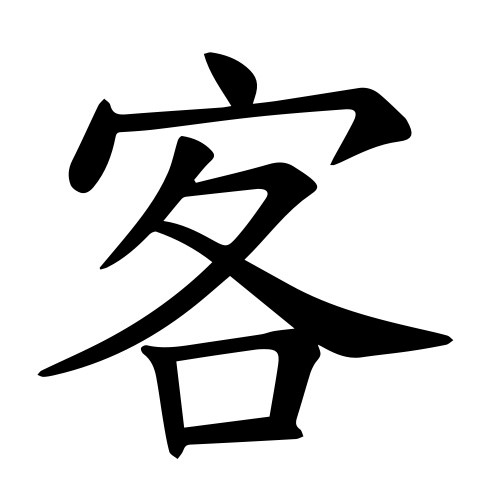
Again with time, it changes and evolves into this one we use today:

Today, the explanation of the character has turned into a different channel: the upper part is still the roof, the middle part, now also means ‘hand’ (really, weren’t hand and foot in the beginning, when we were still animals, the same?) and the lower part, the mouth, indicate this guest who comes under your roof, and you hand this mouth, this guest, something to eat or drink: aren’t we all familiar with this etiquette?

So a guest could be an unsettling thing, a stranger, a possible enemy, or most likely it’s just some tired traveller who asks for a roof.

Aren’t we all have the experience of being this guest, this tired traveller? Timid under the strange roof, holds the bowl of rice wine he is offered and drinks and nods and smiles with all politeness.

And is it any wonder the Chinese way of replying “thank you” is “no guest air” 不客气 bu4ke4qi4: don’t be a guest?